
Excellencies,
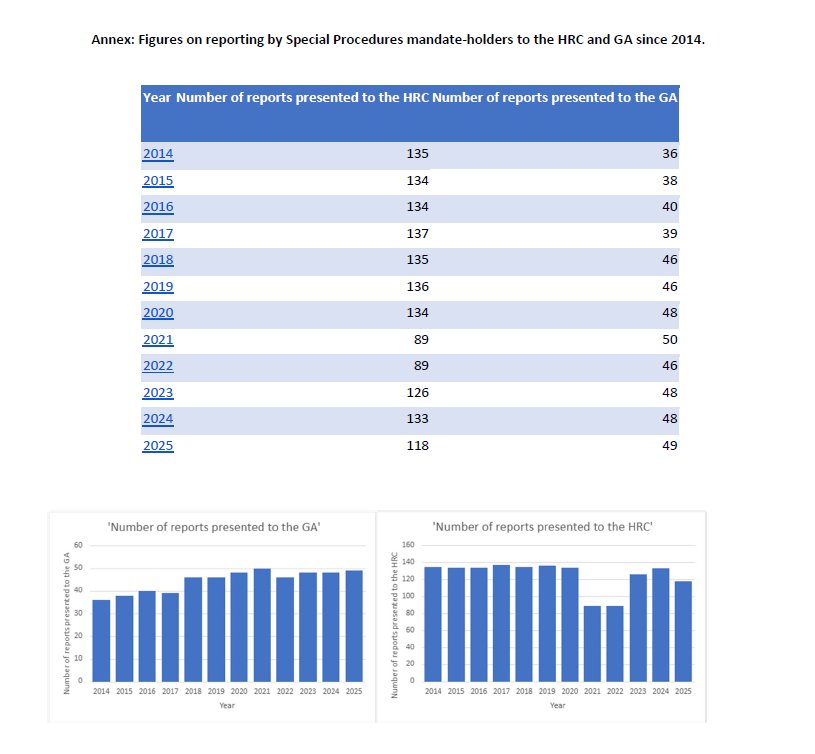
We write to you regarding ongoing discussions at the Human Rights Council on the periodicity of reporting of Special Procedures to the General Assembly. Such reporting is critical to ensure that the General Assembly and the entire UN membership are informed of key human rights issues and situations, including their implications for international peace, security and sustainable development. Visibility of the vital work of Special Procedures in New York is also important to build political support for the UN’s human rights pillar and secure adequate, predictable and sustainable financing for the system.
We acknowledge the adoption by the General Assembly of resolution 79/192 on the working methods of the Third Committee, which seeks to ‘achieve a manageable workload for the Committee and ensure the high quality of its deliberations.’
While we appreciate the need for efficiency and coherence across mechanisms as part of a strategic response to the present challenges, we wish to express serious concerns regarding the overall approach that appears to be advanced at HRC61.
Concerns
- One-size-fits-all approach: Several initiatives proposed during this 61st session appear to adopt a standardised approach with the aim of addressing a variety of objectives, including the Third Committee’s workload, cost-saving and rationalisation, rather than pursuing a strategic and mandate-specific assessment of impact and opportunities. We urge caution against applying blanket reductions of reporting to the General Assembly without a thorough understanding of each mandate’s unique circumstances and needs, as well as an assessment of the impact on the visibility of the issue at stake in New York and strategic alternatives to achieve rationalisation.
- Lack of consultation: Many proposals appear to have been advanced without meaningful consultation with the directly affected communities and concerned mandate holders, with sufficient time ahead of the Human Rights Council session, around the implications of reduced reporting to the General Assembly, and possible alternatives.
- Reference to ‘Roadmaps’ document: The document titled Implementation of GA resolution 79/192 – Elements for a Roadmap, requested in operative paragraph 3 of the resolution 79/192, was presented and discussed, but not formally adopted by the General Assembly. It is instead a set of guiding principles for the progressive reduction of the number of mandates reporting to each session of the Third Committee by an indicative 3–5 mandates per year until its 84th session, in total between 12-20 reports. Further, with approximately 29 thematic mandates up for renewal between 2026 and 2027, the cuts contemplated at HRC61 would already effectively exhaust the proposed quota of reductions for 2026. Without collective thinking on rationalisation across all mandates to be renewed this year to ensure ‘balance on substance’, as requested by resolution 79/192, this risks generating disparities amongst mandates on resources and visibility of issues. The current initiatives would overwhelmingly impact civil and political rights mandates, thereby also affecting the quality of the work of the Third Committee. This also disincentivises core groups and penholders from considering rationalisation efforts in remaining HRC sessions in 2026 and beyond.
- Contextual considerations: One-size-fits-all solutions fail to account for the specific context of each mandate. For example, the water and sanitation mandate has been cited as a strategic example for reducing reporting in 2025. However, the broader context of its resolution, including instructions related to the 2026 and 2028 UN Water Conferences and Sustainable Development Goals reporting requirements, is essential to understanding its reporting frequency.
- Resources and extraordinary character: Initiatives to biannualise or triannualise reporting to the General Assembly without reference to the temporary and extraordinary aspect of such measures risk entrenching this practice in the long-run, including a reduction of resources allocated from the Regular Budget to reflect the reduction in GA reporting.
Suggested Criteria and Process
We call on all States to ensure that any decision to reduce reporting to the General Assembly:
- Be based on a rigorous, mandate‑specific, case-by-case assessment of the needs and added value of each mandate’s reporting frequency;
- Ensure balance on the visibility and substance of issues addressed by the Third Committee, considering the overarching aim to strengthen human rights protection, including those who defend human rights.
- Include transparent justification and meaningful consultation with affected communities and mandate holders, in advance of the circulation of the zero draft;
- Clearly outline the impact on mandate effectiveness and implications for political visibility of the issue in New York.
- Comply with the Council’s founding resolution 5/1 when it comes to the review, rationalisation, and improvement of mandates, ensuring the goal of improving the enjoyment and protection of human rights and ensuring that efficiency gains do not inadvertently weaken key human rights protections.
Contingency Measures
If proposed reductions are not reversed:
- Resolutions should include safeguards to mitigate negative impacts. For example, a written report and a virtual oral presentation should be maintained in the absence of an in-person dialogue and presentation to the General Assembly, maintaining visibility and political attention without overloading the Third Committee’s agenda.
- Savings arising from the reduction of reporting to the General Assembly should be redirected to other activities, unrelated to General Assembly reporting, to be mandated in the resolution and undertaken by the mandate holder. This may include regional conferences, toolkits, guidances and other types of publications, and other relevant activities determined in consultation with the mandate holder.
- Resolutions should make explicit the temporary and extraordinary nature of such measures and, instead of biannualising or triannualising, they should specify the exact sessions of the GA to which mandate holders are expected to report, including a reference to reassessing this in the following renewal, after 3 years.
We trust that these concerns and recommendations will be taken into account in the ongoing deliberations to ensure that any adjustments to reporting requirements are both strategic and consistent with the United Nations’ human rights obligations.
Please accept, Excellencies, the assurances of our highest consideration.
Signatories:
- International Service for Human Rights (ISHR)
- Amnesty International
- West African Human Rights Defenders’ Network
- ILGA World
- Hivos
- Women Deliver
- Cairo Institute for Human Rights Studies (CIHRS)
- Geneva for Human Rights – Global Training & Policy Studies
- Unrepresented Nations and Peoples Organization (UNPO)
- World Organization against Torture (OMCT)
- Privacy International
Share this Post