
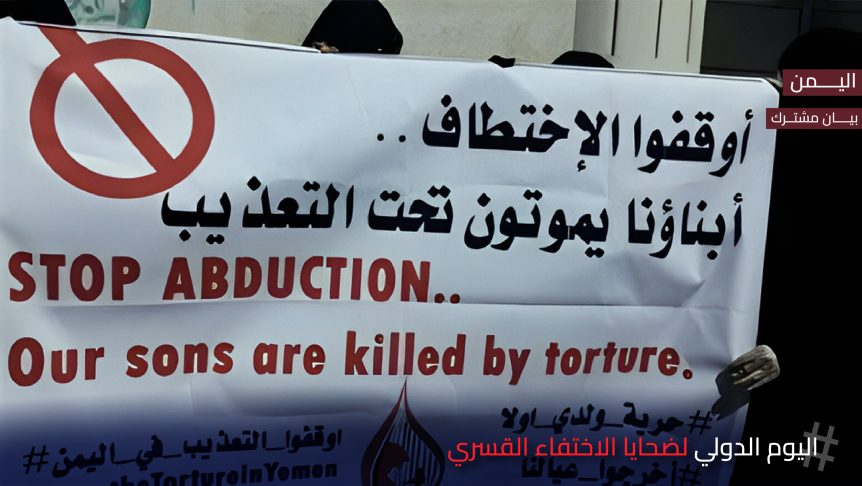
Enforced disappearance in Yemen is a worsening humanitarian and human rights crisis. It has become a deliberate tool to intimidate opponents, silence critical voices, and spread fear within society, operating far from any legal oversight or judicial accountability.
Since the escalation of the conflict in Yemen in 2014, local and international organizations have documented thousands of forcibly disappeared persons. However, the actual numbers are likely far higher due to the concealment and misinformation policies adopted by all parties to the conflict, as well as the intimidation of families that prevents them from reporting the disappearance of their loved ones.
Human rights reports confirm that all parties to the conflict in Yemen are implicated in committing the crime of enforced disappearance, including the Houthi forces, the Yemeni government, and various armed groups supported by Saudi Arabia and the UAE, particularly the Southern Transitional Council. These actors routinely practice arbitrary detention, enforced disappearance, torture, and ill-treatment of people throughout Yemen.
At least 50 UN and NGO staff members have been detained by the Houthis since last year, without access to lawyers or their families, and without being charged with any crime. The death of a World Food Programme aid worker on February 11 in a Houthi-run detention center has heightened concerns, given the Houthis’ track record of torture and other forms of ill-treatment of detainees. Earlier this year, the Houthis detained 13 UN agency staff members shortly after the UN announced the suspension of all official movements in Houthi-controlled areas of Yemen. Despite repeated calls for their release, the Houthis have largely ignored these appeals and continued their policy of forcibly disappearing opponents in unknown locations.
According to monitoring by the Abductees’ Mothers Association, between January and July of this year alone, 165 civilians were subjected to enforced disappearance in Ibb Governorate. In other governorates, the number reached 153 civilians. On the other side, forces affiliated with the internationally recognized government, the Security Belt Forces of the Southern Transitional Council, and the West Coast Forces committed similar violations. The Association documented 51 civilians forcibly disappeared in 2024 alone, in addition to dozens of cases in Aden Governorate dating back more than seven years, with families still unaware of their loved ones’ fate despite years of appeals.
The crisis is exacerbated by a widespread culture of impunity, which remains the greatest obstacle to addressing enforced disappearance. Perpetrators cover up the fate of victims, refuse to acknowledge their detention, and conceal their places of imprisonment. This compounds the suffering of families, who live in constant anxiety and deep psychological pain, especially women, who bear a heavy economic and social burden while searching for their loved ones.
On the International Day of Enforced Disappearance, we in the Justice for Yemen Pact Coalition stand in solidarity with thousands of victims and their families, who live with the pain of loss and the uncertainty of the unknown. We call on international sponsors of the Yemeni peace talks to make the issue of the forcibly disappeared a top priority. Any transitional justice process must include the creation of a national committee to search for them, address their needs and those of their families, and ensure that their cases are documented for use in future justice mechanisms. We also call for the formation of an international commission to investigate crimes committed against the forcibly disappeared to preserve evidence and ensure accountability.
Driven by our moral, human rights, and humanitarian responsibilities, and in loyalty to the suffering of the victims and their families, we present the following recommendations to the concerned authorities:
All parties must immediately end enforced disappearances and arbitrary arrests, respect international standards in the treatment of detainees, disclose the whereabouts of the forcibly disappeared, and release them without delay.
The internationally recognized Yemeni government must fully accede to the International Convention for the Protection of All Persons from Enforced Disappearance, harmonize national legislation with international treaties, establish an independent national committee to investigate cases, address the needs of victims and their families, prosecute perpetrators, and share relevant information with stakeholders.
The international community and the United Nations must exert serious pressure on all parties to the conflict to fulfill their obligations under international law and reveal the fate of the disappeared. The Human Rights Council should establish an independent international commission to investigate violations of international law in Yemen, including those committed by non-Yemeni actors, and ensure the issue of the disappeared is addressed.
National and international actors should work to strengthen and protect local human rights and civil society organizations, especially those operating under Houthi control.
Signatory Organizations:
- Abductees’ Mothers Association (AMA)
- Al-Amal Women’s and Sociocultural Foundation (AWSF)
- Center for Strategic Studies to Support Women and Children (CSWC)
- Free Media Center for Investigative Journalism
- Marib Dam Foundation for Social Development (MDF)
- Musaala Organization
- SAM Organization for Rights and Liberties
- Studies and Economic Media Center (SEMC)
- Yemeni Media Freedom Observatory (YMFO)
- Watch for Human Rights (Watch4HR)
- Civil Commission for Houses Bombing Victims
- Global Centre for the Responsibility to Protect (GCR2P)
- Cairo Institute for Human Rights Studies (CIHRS)
- Peace Track Initiative
- Together We Rise Foundation for Women and Child Care
- Foundation for the Defense of Rights and Freedoms
- Monitoring Center for Rights and Development
- Babylon Obelisk Network for Human Rights
- Youth Creative Meeting
- Alhaq organization for human rights
- Electronic Organization For Humanitarian Media EOHM
Share this Post