
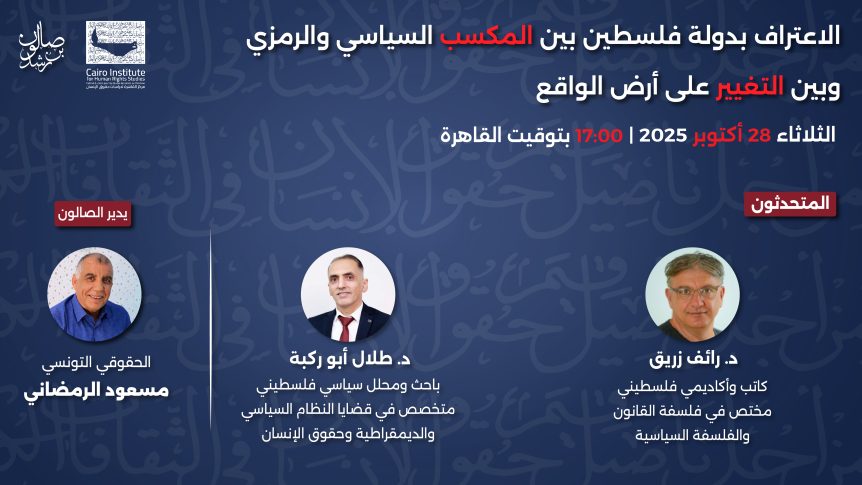
On 4 November 2025, the Cairo Institute for Human Rights Studies (CIHRS) held its monthly Ibn Rushd Salon, on the broader implications of the recent recognition of the State of Palestine by several European countries as well as the key outcomes of the truce agreement, the Sharm El-Sheikh Conference, and the New York Declaration. The Salon hosted Dr. Raef Zreik, a Palestinian writer and academic specialising in the philosophy of law and political philosophy, and Dr. Talal Abu Rokbeh, a Palestinian researcher and political analyst specialising in political systems, democracy, and human rights. The discussion was moderated by Tunisian human-rights advocate Messaoud Romdhani.
At the outset, Dr. Zreik emphasised that international resolutions and declarations do not, in themselves, bring about independence or end occupation; rather, shifts in the balance of power on the ground do. While international decisions may be a necessary condition for change, they alone are insufficient. Likewise, the use of force in disregard of international resolutions and agreements will not lead to independence. What is required is the convergence of both factors: international recognition and effective capacity to act on the ground. Zreik added, ‘If Arabs succeed in utilising and leveraging the balance of power, we may be able to capitalise on these international resolutions and recognitions to effect real change on the ground’.
Dr. Talal Abu Rukbeh also highlighted that the greatest threat — the existential threat — to the Zionist project lies in the Palestinian demographic presence, and that eliminating the Palestinian population is seen as the only way to complete this project. Accordingly, the occupation state has long sought to fragment and suppress Palestinian unity through various means, reaching the level of genocide. He noted that all Israeli practices before 7 October— including the ongoing siege, restrictions on movement, settlement expansion, deliberate obstruction of goods, raids and military attacks, and obstruction of urban development — were aimed at convincing the Palestinian public imagination that remaining and living on the land is impossible, thereby driving people toward emigration. Israel also exploited Operation Al-Aqsa Flood to continue its violations and escalate them toward genocide.
For the same reason, Israel has deepened divisions among the major Palestinian communities, creating specific problems and challenges for each that divert attention from the central issue — from crime proliferation and underdevelopment in the Arab-48 areas, to land confiscation and settlement expansion in the West Bank, and the blockade in Gaza along with military assaults. Similarly, Israel has exacerbated divisions within the Palestinian authorities and fostered the split between Fatah and Hamas, in order to prevent genuine Palestinian unity — the true threat to its Zionist project, which goes beyond mere recognition of state borders to the actual political, social, and economic establishment of a Palestinian state.
Regarding the New York Declaration and Trump’s plan to resolve the crisis, both Dr. Zreik and Dr. Abu Rukbeh considered these attempts to circumvent the two-state solution as lacking principled foundation and a calculated response to Israel’s strategy. Israel had begun deliberately starving Palestinians in Gaza and creating a severe humanitarian crisis, aiming to focus the world’s attention and efforts solely on delivering aid and protecting civilians, rather than on political solutions to the deep structural crises that brought the situation to this point — including seven decades of occupation and how it may end.
According to Dr. Abu Rukbeh, Trump’s plan is a clear circumvention of the two-state solution and a deliberate undermining of it, particularly through the separation of Gaza and the West Bank, and by placing the administration of the Gaza Strip in the hands of international (non-Palestinian) actors, effectively stripping Palestinians of sovereignty over the territory. In fact, he described it as literally ‘meeting the five conditions set by Netanyahu to halt the war initially, without taking into account any of the rights of the Palestinian people as enshrined in international law’.
According to Dr. Zreik, the greatest current challenge lies in the fact that the party clearly willing to reach a settlement with Israel does not simultaneously present a plan for resistance. If Israel does not respond, what tools of pressure are available? There is no Palestinian strategy capable of resisting while also being prepared to negotiate. No party proposes solutions or a vision for resolution while simultaneously possessing the leverage to enforce them, nor is any party ready to negotiate and offer specific concessions in exchange for specific gains. He continues: ‘The reasons that prevented reaching agreements in the past will continue to block any future accord, especially given the increased involvement of many international powers in Palestinian affairs — led by the United States — as well as the multiplicity of regional actors engaged in negotiations (Turkey, Qatar, Egypt). The combination of multiple international and regional players on one hand, and the absence of a unified Palestinian stance and vision on the other, makes the situation even more complex this time. Without internal Palestinian consensus on demands, a plan, and a clear solution, all these parties will only scatter the negotiations’.
Similarly, Dr. Talal Abu Rukbeh emphasised in conclusion: ‘The true bet is the development of a national Palestinian programme based on unity of position and vision, and the building of a unified national Palestinian strategy. In light of the international circumvention of Trump’s proposals and plans, which exclude Palestinians and bypass their unity, there is no alternative but to present a unified Palestinian vision and mobilise Arab pressure to enforce it’.
- Watch the full seminar here:
Share this Post