
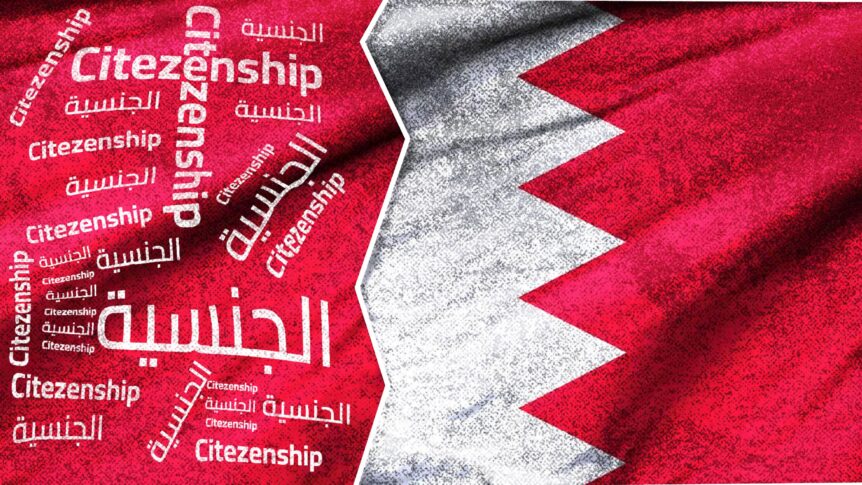
Thirteen human rights organizations expressed grave concern over the Bahraini government’s continued disregard for its international human rights obligations, calling on world leaders to urge Bahrain to reverse its decision of 27 April 2026, which arbitrarily revoked the citizenship of at least 69 Bahraini nationals, and to explicitly commit to ending the policy of arbitrary citizenship revocation.
In this regard, the organizations issued a direct appeal to the United Nations Secretary-General, the UN High Commissioner for Refugees, the UN Refugee Agency, the UN High Commissioner for Human Rights, the President of the European Commission, the EU High Representative for Foreign Affairs and Security Policy and Vice-President of the European Commission, as well as the Prime Minister and Foreign Secretary of the United Kingdom. To date, the organizations have not received any response from the relevant authorities, nor have any measures been taken in relation to the appeal.
The signatory organisations acknowledged reports that Bahrain alleged that the 69 individuals sympathised with Iranian attacks on Bahrain in the context of the 28 February – April 2026 armed conflict between the United States and Israel and Iran. These allegations were made without the presentation of any supporting evidence, without a judicial ruling confirming the claims or ordering the deprivation of nationality, and in the absence of any mechanism to challenge the decision. According to available reports received by the organisations, at least 26 children were among those stripped of their citizenship, with ages ranging from 23 days to 14 years. The Bahraini Ministry of Interior has limited its response to stating that the individuals concerned are of non-Bahraini origin.
Bahrain’s Interior Ministry reportedly alleged that those targeted are of “non-Bahraini origin.”
The human rights groups noted that the revocation decision relied upon a 2014 amendment of the 1963 Bahraini Nationality Law, entitled Law No. (21) of 2014. It states that:
“By decree, based on a proposal from the Minister of Interior and with the approval of the Cabinet, Bahraini citizenship may be revoked from anyone who possesses it in any of the following cases: […] (3) If he causes harm to the interests of the Kingdom or acts in a manner contrary to his duty of loyalty to it.”
The rights groups condemned a 2024 Royal Decree that abnegates judicial oversight of citizenship revocation. The decree frames nationality as a sovereign issue, above judicial scrutiny, which contradicts the principle laid out in both international human rights law and Bahrain’s constitution affirming that an independent judiciary is to provide oversight to government policy and practice.
The signatory organisations appealed to UN, EU and UK leaders in the absence of engagement by Bahrain, to call on the government of Bahrain to:
- Rescind its arbitrary revocation of citizenship for the 69 persons named to date and restore their nationality and related rights and benefits;
- Expressly rule out further arbitrary revocations of citizenship;
- Monitor the expulsion of any person deprived of Bahraini nationality with a view to ensuring their safety;
- Remind the Bahraini authorities of the need for any decision relating to nationality to be subject to an independent judicial process, with full guarantees of the rights of defence and appeal; and
- Urge Bahrain to make good on UN treaty bodies’ longstanding recommendations to align its legislation with international standards, including the conventions on the prevention of statelessness.
In November 2025, the United Nations Committee against Torture issued its Concluding Observations in relation to the Bahrain’s implementation of the treaty. In paragraph 40 (c) the Committee expressly recommended that Bahrain: “Refrain from using revocation of citizenship as a form of reprisal against human rights defenders, journalists, political opponents and other critics of the Government.”
Drewery Dyke, from Salam for Democracy and Human Rights, stated that “By acting against the express wishes of UN treaty bodies, the government of Bahrain has turned away from international rule of law and adherence to international human rights standards.”
Background
After weeks of inflammatory discourse directed overwhelmingly at Shi’a Bahrainis and the imposition of increasing restrictions on the rights to freedom of expression and association, on 20 April 2026, the Office of Bahrain’s Prime Minister reported that the Cabinet [of Ministers] would implement ruler Hamad bin ‘Isa al-Khalifa’s “comprehensive and decisive measures” including “legal measures against those who have betrayed the nation or undermined its security and stability, alongside a review of cases relating to entitlement to Bahraini citizenship […]” . The Cabinet resolved to review the legal “frameworks related to nationality, examining cases in line with national standards to safeguard national identity, reinforce the values of national loyalty, and ensure that necessary measures are taken in full accordance with the law.” [1]
The conduct of the Bahraini authorities indicates that Bahrain is conducting a widespread, arbitrary citizenship revocation campaign, as it did between 2012-2019, when the government stripped the citizenship of Bahrainis on grounds related to the exercise of the right to freedom of expression or association, in the absence of fair trial guarantees or effective remedies.[2] Bahrain has transgressed the prohibition on creating statelessness, in violation of the fundamental human right to a nationality.
The signatory organisations acknowledged government action that restored Bahraini nationality to at least 551 of the 985 people whose citizenship Bahrain had arbitrarily revoked in previous years. The government’s return to such violations has raised considerable alarm throughout Bahraini society, undermining social cohesion.
Signatory Organisations:
- ALQST for Human Rights
- Bahrain Forum for Human Rights
- Cairo Institute for Human Rights Studies (CIHRS)
- CIVICUS
- Gulf Center for Human Rights
- Gulf Institute for Democracy and Human Rights
- Hawiati – MENA Statelessness Network
- Institute on Statelessness and Inclusion (ISI)
- MENA Rights Group
- Nationality For All (NFA)
- The Right to Be Campaign
- Rights Realization Centre
- Salam for Democracy and Human Rights
- Gulf Center for Human Rights
[1] Government of Bahrain, Prime Minister’s Office – News / The Deputy Prime Minister chairs the weekly Cabinet Meeting, 20 April 2026, https://www.pmo.gov.bh/en/article/the-deputy-prime-minister-chairs-the-weekly-cabinet-meeting-2026-04-20 , accessed 21 April 2026
[2] According to AnaBahraini (“I am Bahraini”), the government has revoked the nationality of 434 persons. In 2012 the GoB stripped the citizenship of 31 persons; 21 in 2014; 208 in 2015; 90 in 2016; 156 in 2017; 298 in 2018;and 181 in 2019. To date, the government has reinstated the nationality of 551 people. See: https://had www.anabahraini.org/
Share this Post