
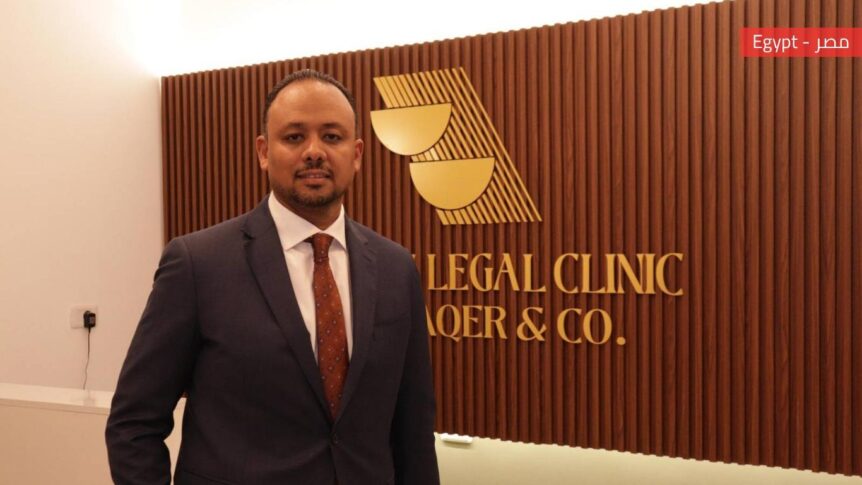
The undersigned organizations condemn the five-year extension of human rights lawyer Mohamed El-Baqer ‘s inclusion on the ‘terrorist list,’ pursuant to a decision by the First Circuit of the Criminal Court and at the request of the Public Prosecution. The organizations call on the Court of Cassation to accept the appeal filed against this decision during the upcoming June 13 session.
El-Baqer continues to be deprived of his constitutional rights, including the right to a fair trial, freedom of movement, the right to property, and the right to participate in public life, according to the Criminal Court’s decision issued in November 2025 under the presidency of Counselor Mohamed El-Sherbiny. Despite a presidential pardon issued approximately three years ago for the sentence imposed on him, El-Baqer remains banned from travel, from engaging in any public activity, from disposing of his funds and property, and even from issuing powers of attorney.
Next Saturday, 13 June, the (B) Circuit of the Court of Cassation will consider the appeal filed by El-Baqer against the judicial decision issued against him, which is not based on any real evidence. There are no clear or publicly announced criteria that can be relied upon to explain the actual reasons behind the inclusion or extension of inclusion of individuals on the terrorist list. Moreover, El-Baqer has never been interrogated nor officially informed of the reasons for his listing.
It should be noted that under Law No. 8 of 2015 to Regulate Terror Group and Terrorist Lists, individuals and entities are included on such lists upon a request submitted by the Public Prosecutor to the court, accompanied by investigations, documents, intelligence reports, or even merely supporting information. In most cases, terrorist listings are based on Interior Ministry investigations, which amount to the opinion of the Interior Ministry and do not constitute conclusive evidence of guilt according to rulings of the Court of Cassation. The court needs only to be satisfied with the credibility of these investigations, without relying on substantiated evidence or strictly defined legal standards, before issuing its decision.
El-Baqer spent approximately four years in prison after being held in pretrial detention in several similar cases. He was released in July 2023 after receiving a presidential pardon for the remainder of a four-year sentence issued by the Emergency State Security Misdemeanor Court in December 2021 on charges of ‘spreading false news’ in Case No. 1228 of 2021. Nevertheless, this pardon did not terminate the case under which he was originally arrested (Case No. 1356 of 2019 – Supreme State Security), nor the third case (No. 1781 of 2019) that led to his inclusion on the terrorists list, nor even Case No. 855 of 2020 (Supreme State Security), in which he was investigated while in prison.
El-Baqer’s freedom remains restricted despite the presidential pardon. His unjustified inclusion on the terrorists list continues to deprive him of his most basic constitutional rights, unlike others in similar legal positions. For example, lawyer and former MP Ziad El-Elaimy was removed from the terrorists list in November 2023, following his listing based on investigations in a case in which he had never been questioned, and more than a year after his release pursuant to a presidential pardon for the remainder of his sentence issued by the Emergency State Security Court. Similarly, programmer Alaa Abdel Fattah was removed from the terrorists list in July 2025. He had been a co-defendant with El-Baqer in the same case and listed on the same basis, prior to a presidential pardon and his release in September 2025.
The undersigned organizations stress the necessity of ending the harassment of El-Baqer on account of his peaceful and lawful human rights work. His continued inclusion on the terrorists list, along with the travel ban and asset freeze imposed on him, constitutes a form of reprisal against human rights defenders, according to the United Nations Secretary-General. This approach is inconsistent with the position of the Presidency following the issuance of his pardon and its recognition of him as a human rights expert, as evidenced by his participation in the National Dialogue session on pretrial detention.
Signatories:
- Egyptian Initiative for Personal Rights
- Elnadeem Against Violence and Torture
- Refugees Platform in Egypt
- Support for Law and Democracy Foundation
- Egyptian Front for Human Rights
- Masaar Foundation
- Egyptian Commission for Rights and Freedoms
- Egyptian Human Rights Forum
- EgyptWide
- Association for Freedom of Thought and Expression
- Justice Committee
- Cairo Institute for Human Rights Studies
Share this Post