
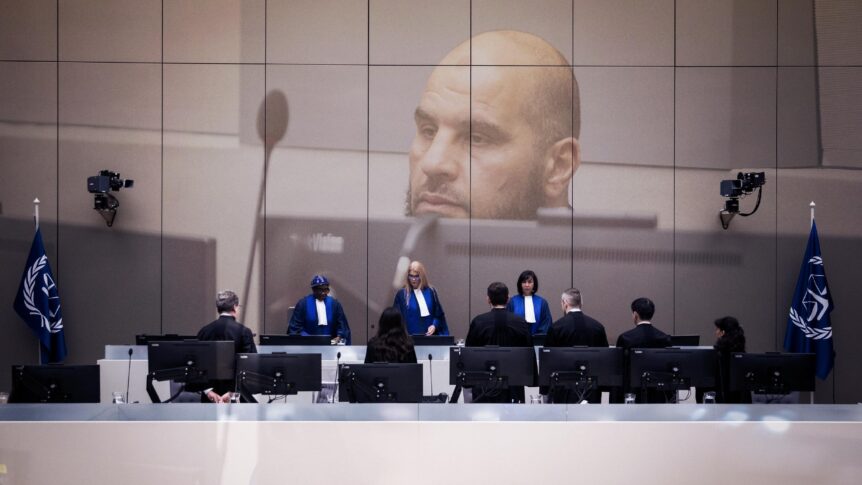
In an important step toward accountability for serious international crimes committed in Libya, former Mitiga Prison security official Khaled Mohamed Ali El-Hishri appears today before the International Criminal Court, facing trial on 17 charges amounting to crimes against humanity and war crimes.
On 16 July 2025, German authorities arrested El Hishri pursuant to an ICC arrest warrant issued on 10 July 2025. He faces 17 charges of war crimes and crimes against humanity allegedly committed in Libya between February 2015 and early 2020. He was transferred to The Hague on 1 December 2025.
El Hishri is a former senior official of the Special Deterrence Force for Combating Terrorism and Organized Crime (also known as RADA), an armed group formally affiliated with the Libyan Presidential Council, but in practice operates with substantial autonomy and functions as a powerful militia. He allegedly oversaw Mitiga Prison in Tripoli, where detainees were subjected to serious human rights violations, including arbitrary detention, torture, enforced disappearance, sexual violence and other abuses.
For over a decade, victims and survivors of abuses committed in Mitiga Prison, and their families, have been denied justice and effective remedy in Libya. Germany’s execution of the ICC arrest warrant demonstrates that when political will exists, accountability is achievable. The proceedings represent a significant opportunity to challenge the entrenched culture of impunity that continues to fuel violence and serious human rights violations across Libya. Despite the persistent failure of Libyan authorities to hold perpetrators accountable or provide meaningful avenues for justice, the proceedings send an important message that justice for grave crimes remains possible.
At the same time, the El Hishri case also exposes the profound structural obstacles that continue to undermine justice in Libya. Armed groups continue to exercise significant influence over detention facilities and judicial processes, while judges, prosecutors, lawyers, and witnesses remain vulnerable to threats, intimidation, and violence. The continued ability of armed actors to interfere in the processes of arrest, detention, prosecution and the implementation of judicial decisions severely undermines the rule of law and victims’ access to justice.
Cooperation with the ICC remains a legally binding obligation on all Libyan authorities, particularly following Libya’s declaration accepting the Court’s jurisdiction over crimes committed on Libyan territory from 2011 until the end of 2027. This obligation requires full and effective cooperation with the Court, including the execution of arrest warrants and the surrender of all individuals sought by the ICC.
Cooperation by States Parties to the Rome Statute is equally essential to ensuring accountability for international crimes. The case of Osama Elmasry Njeem, the former head of Libya’s Judicial Police Authority, demonstrated the serious consequences of failure to uphold these obligations. Despite being subject to an ICC arrest warrant for alleged crimes against humanity and war crimes, including murder, torture, rape, and sexual violence committed in Libya’s prison system, Njeem was released by Italian authorities and returned to Libya only days after his arrest, undermining prospects for justice and accountability for victims. Although Libyan authorities announced his arrest in Tripoli on 5 November 2025, until now they have failed to surrender him to the ICC.
Seven additional ICC arrest warrants in the Libya situation remain outstanding and must be enforced without delay. They include warrants unsealed in October 2024 against suspects linked to the Kaniyat armed group for crimes committed in Tarhuna between 2013 and 2020. On 3 February 2026, Libyan politician Saif al-Islam Gaddafi was killed despite an active ICC warrant. Held by a Zintan armed group from 2011 until his release in June 2017, he evaded justice for fifteen years. His assassination denies victims truth and reparation. As for military commander Mahmoud al-Werfalli, subject to ICC warrants in 2017 and 2018 for alleged summary executions, he remained active in eastern Libya until his killing in March 2021. These cases illustrate the same pattern: armed actors obstruct international proceedings, then violence ensures perpetrators never face accountability.
The organisations call on the international community, including the United Nations and States Parties to the Rome Statute, to continue providing strong political and practical support to the ICC and to ensure that the Court has the resources necessary to carry out its mandate independently and effectively. They also stress the importance of protecting and supporting victims, witnesses, and Libyan civil society organisations working to document violations and pursue accountability.
The organisations further call for meaningful structural reforms to Libya’s detention and justice sectors, including ensuring that all detention facilities operate under effective judicial oversight and are protected from interference by armed groups. International cooperation with Libyan authorities, including in the areas of security and migration management, should not contribute to empowering actors implicated in serious human rights violations or international crimes.
The opening of proceedings against El Hishri should mark the beginning of a broader and more credible process capable of establishing the truth, delivering justice to victims and survivors, and ensuring that all those responsible for international crimes in Libya, regardless of their rank or affiliation, are held accountable.
Signatory Organisations:
- Cairo Institute for Human Rights Studies (CIHRS)
- Libya Crimes Watch (LCW)
- Adala For All (AFA)
- Libya Platform Coalition for Human Rights
- Libyan Network for Legal Aid
- Association Indépendante des Droits Humains
- World Organisation Against Torture (OMCT)
Share this Post