
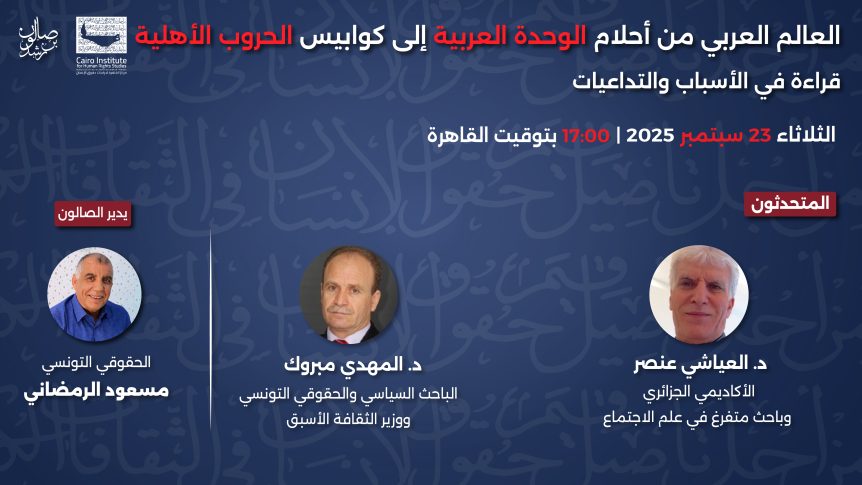
On 23 September 2025, the Cairo Institute for Human Rights Studies (CIHRS) held its monthly Ibn Rushd Salon under the title: ‘The Arab World: From Dreams of Arab Unity to Nightmares of Civil Wars – A Reading into Causes and Consequences’.
The discussion featured Dr. Mehdi Mabrouk, Tunisian human rights advocate, politician, and former Minister of Culture; Dr. Al Ayachi Ansar, Algerian academic specializing in sociology; and was moderated by Messaoud Romdhani, Tunisian human rights defender.
Dr. Al Ayachi Ansar began by unpacking several structural factors that, in his view, explain the fragility and eventual failure of Arab unity projects, especially when compared with successful European models such as the European Union. According to Dr. Ansar, the first factor behind the failure of Arab unity initiatives lies in the historical formation of the Arab nation-state, which emerged under a heavy colonial legacy. Current borders between Arab states were drawn by colonial powers with little regard for demographic, ethnic, or social diversity, resulting in states internally heterogeneous in composition, with distinct groups forcibly merged into single administrative entities. The second factor relates to the economic structures of Arab regimes. Most are built on rentier economies; whether based on natural resources like oil and gas or on foreign aid. This has created fertile ground for corruption and clientelism, while deepening the disconnection between citizens and the state.
The third factor in the failure of Arab unity projects concerns the political structures of Arab regimes. Most lack genuine political legitimacy, either because they originated from military coups (where the army seized power), rely on hereditary rule (as in the Gulf monarchies), or are dependent on individual leadership rather than institutions. This is reinforced by centralized authority, the dominance of security solutions, and the absence of democratic governance, all of which exacerbate marginalization and division. Finally, the fourth factor is external intervention. Dr. Ansar explained that the region’s geostrategic importance and its wealth of resources have made it a constant arena for global power struggles and foreign interference; whether by propping up authoritarian regimes or fueling divisions within societies.
Beyond the four structural factors already discussed, Dr. Mehdi Mabrouk argued that there are additional reasons linked to Arab societies’ own acceptance or rejection of the concept of regional unity. He stressed that Arab unity in the collective popular imagination has become synonymous not with liberation, but with repression. Attempts at unity were often imposed from above by authoritarian regimes that deployed the rhetoric of liberation to justify curtailing freedoms, making repression—especially of minorities—the dominant feature. In reality, the slogans of unity raised by these regimes served as a cover for dismantling individual citizenship and equal rights.
According to Dr. Mabrouk, a second factor is the absence of direct benefits for ordinary citizens. The European model of integration was grounded in tangible economic and social interests that positively impacted daily life, fostering a shared sense of gain from unity. By contrast, Arab unity initiatives were tied to ideological discourse rather than practical benefits, leaving Arab citizens detached from the project, if not actively alienated by it. Thus, unity has long been a project of regimes, not a grassroots demand. Each time a regime collapsed, so too did the idea of Arabism. Reviving any serious project of Arab integration therefore requires rebuilding it through societal will from the ground up.
In this context, Dr. Al Ayachi Ansar warned of the dangers of sidelining political, social, and cultural elites from the unity project. For them, such projects appeared as top-down initiatives imposed by ruling authorities, who then tasked these elites with promoting them without debate. Meanwhile, elites themselves have been deprived of openness to and collaboration with external experiences that could enrich them. For example, most Arab universities today remain insular, without a single foreign professor, and the same applies to leading cultural institutions and artistic or social initiatives. This institutional closure reflects a broader condition of isolation and inwardness, in stark contrast to the foundations of successful integration elsewhere.
Dr. Ansar added: ‘The European experience was built on agreements among diverse social forces, including cultural and academic actors, based on shared interests rather than ideology. In the Arab world, unity projects remained confined to the ruling authority—announced from above, then marketed by elites. Add to this the absence of joint strategic thinking and the systematic exclusion of stakeholders, and the result is fragile projects that collapse as soon as the sponsoring regime falls.’
Dr. Mabrouk further remarked that Arab ruling regimes inherited the postcolonial nation-state but failed to rethink how to govern diverse societies. Instead, they revived colonial tools of domination, focusing on repression and marginalization rather than organization and participation. They entrenched themselves through military force or behind a particular ideological, religious, or sectarian framework, which they then imposed on all segments of society through coercion. Post-independence societies were thus built not on recognition and celebration of diversity, but on denial and fear of it. Arab regimes resorted to populist ideologies that glorified false homogeneity under the slogan of ‘one nation’. Such illusions collapse with the fall of regimes, at which point long-marginalized groups erupt with accumulated historical rage. Societies then rediscover themselves, but through bloody conflicts rather than peaceful coexistence. Mabrouk warned that the persistent conflation of state and regime leads societies to destroy the state itself once the regime falls.
Dr. Mabrouk emphasized that ethnic and sectarian pluralism can be a source of strength—if managed democratically and on the basis of justice and equality. Instead, in the absence of recognition policies, diversity has been turned into a source of conflict. This has produced a sharp contradiction: while constitutions proclaim unity, cohesion, and shared interests, political practice enacts the marginalization of diverse demographic and religious realities on the ground.
In conclusion, Dr. Al Ayachi Ansar presented possible pathways out of this cycle, stressing that no project of integration or unity can succeed without embracing genuine democracy that includes everyone, effective representative institutions, and clear laws applied with fairness. The law, he argued, must stand above all, rather than serve as a tool of the regime. The state must be governed as an institution serving a diverse society, not as a power imposing its will upon it. He linked the liberation of peoples to their awareness of their own worth and diversity, stressing that long-standing repression has deprived them of discovering their strengths and robbed them of opportunities for creative coexistence.
- Watch the full seminar here:
Share this Post