
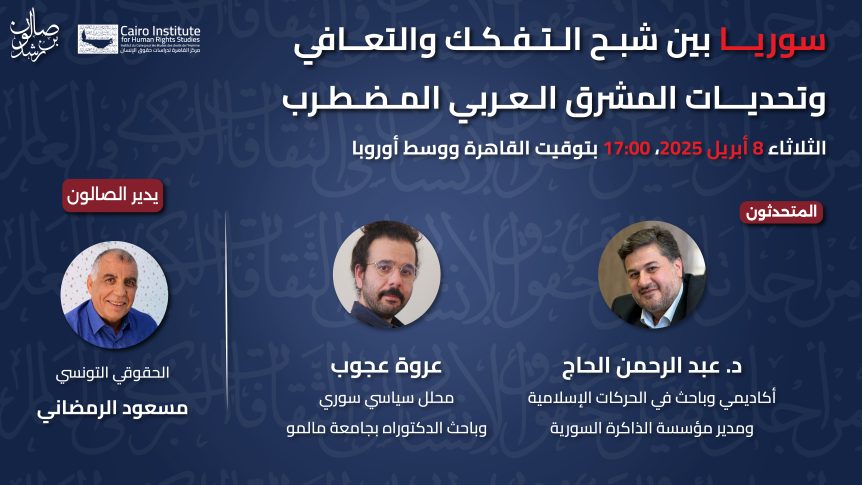
Four months after the fall of the Assad regime, Syria stands at the threshold of a new phase—one fraught with both promise and peril. This was the focus of discussion at this month’s Ibn Rushd Salon, organized by the Cairo Institute for Human Rights Studies (CIHRS), under the title ‘Syria Between Fragmentation and Recovery: Navigating the Turmoil of the Arab East’.
The salon hosted Dr. Abdulrahman Al-Haj—an expert on Islamic movements, former advisor to the Syrian interim government, and director of the Syrian Memory Center—and Mr. Orwa Ajjoub, a Syrian political analyst and doctoral researcher on jihadist religious discourse at Malmö University in Sweden.
The two guests shared their readings of Syria’s internal prospects and the implications for the region’s shifting alliances. The discussion was moderated by Tunisian human rights advocate Messaoud Romdhani.
Dr. Al-Haj opened on a cautiously optimistic note, emphasizing that there are relatively positive developments in Syria today that cannot be overlooked. He also pointed out the presence of certain fundamental constants that no ruling authority can bypass, which in turn strengthen the possibility of meaningful political transformation. Among the most important of these, he argued, is the fact that ‘Syria is, and will remain, a republic. It cannot be transformed into another model. This republican reality inherently necessitates a democratic path; one that requires political parties, an electoral law, and guaranteed freedoms of expression and voting, among other things. So, the framework for such a path exists, even if its final form is still in the making’.
Al-Haj acknowledged that some initial indicators are indeed concerning, such as the constitutional declaration, which suggests that power is heavily concentrated in the hands of the president; this, according to Al-Haj, is somewhat natural in a transitional phase for a state that has experienced violent military events and conflicts while transitioning to a new regime through military operations. He continued, ‘Today, we are not speaking about a political system, but rather about a transitional stage that will create a permanent political system. This permanent political system will certainly go through the matter of political parties and through a constituent committee to negotiate with the diverse communities of Syrian society on sensitive issues, foremost among them the relationship between religion and the state and the role of each sect in managing the country’.
On the other hand, Mr. Ajjoub offered a more cautious perspective, considering the situation still unclear and noting that many agreements—such as the one between the new leadership and the Syrian Democratic Forces (SDF)—carry numerous uncertainties. According to Ajjoub, although it was indeed a historic moment for all Syrians when Mazloum Abdi and Ahmad Al-Sharaa met to sign the agreement for the first time, ‘the devil is in the details’. The agreement remains somewhat vague: there is no mention of disarmament, and questions remain about the security apparatus and institutions. Will the security bodies and institutions in northeast Syria be integrated with their counterparts in Damascus? It is important to note that even after the agreement, Turkish airstrikes on SDF positions continued, and clashes persisted between the National Army and the SDF.
Ajjoub added, ‘I imagine there is a faction within the SDF that supports the agreement, while another faction—specifically the Syrian Democratic Council—rejects it or perhaps doubts its effectiveness, especially after the constitutional declaration. Similarly, I believe Suwayda is waiting on the outcome of the SDF agreement; the SDF, in turn, awaits an agreement with Suwayda, which itself looks to Daraa. Everyone is watching to see what these agreements with the new Syrian leadership will ultimately bring, and what consequences will follow’.
Ajjoub also touched on the regional dimension of the agreement, questioning the American response to it. Will the U.S. military withdraw from Syria? Will America’s stance toward Syria change? He concluded by saying, ‘I believe it is too early to assess the effectiveness of this agreement, especially since much depends on the Americans on one hand, and on Ahmad Al-Sharaa’s willingness to unify the country on the other.’
Regarding the regional repercussions of developments in Syria, Al-Haj affirmed that the fall of the Assad regime has brought about major strategic changes, most notably the breaking of the ‘Iranian Crescent’ and a significant weakening of Tehran’s influence in the region. This shift has had a direct impact on the positions of its allies in Lebanon and Iraq. He also observed that Turkey, previously the main partner of the opposition, now faces a historic opportunity to strengthen its role as a regional power by assisting in rebuilding the Syrian army and securing its economic and strategic interests.
Meanwhile, Ajjoub focused on another key player in the region: Israel, and the implications of the new Syrian leadership for its policies. Ajjoub argued that the recent Israeli strikes—officially claimed to be aimed solely at containing Turkish influence in Syria—also seek to ensure that Syria remains a state incapable of threatening Israel’s security in the future. This may explain why, shortly after Al-Sharaa entered Damascus, Israeli strikes targeted approximately 70 to 80 percent of Syria’s advanced weaponry. This is a clear message that while Israel recognizes that Al-Sharaa’s ideology has changed, he does not control all armed factions and will not be able to exert authority over all this military equipment. Therefore, as a precautionary measure, Israel seeks to ensure that these weapons remain out of the hands of groups beyond Al-Sharaa’s control. He added, ‘The Israelis now believe the regional opportunity is ripe to secure the greatest possible gains on military and security levels’.
Watch the full seminar here:
Listen to this episode on the Ibn Rushd Salon podcast:
Share this Post