
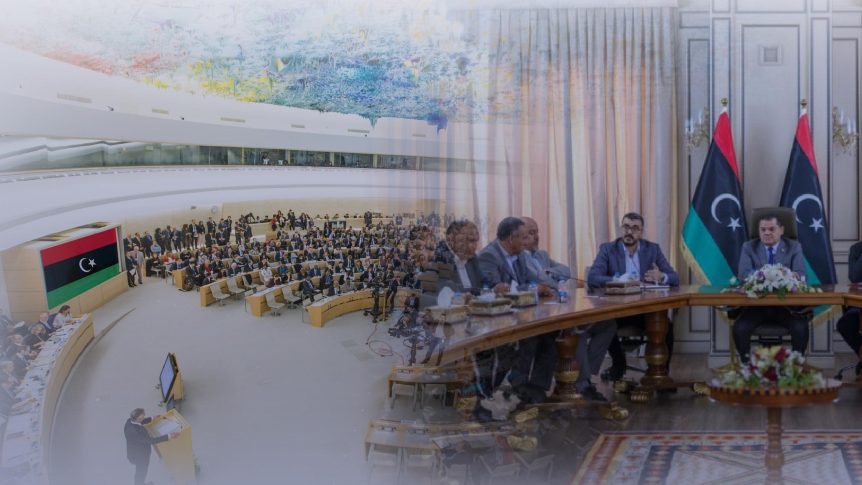
Your Excellency, Prime Minister Abdul Hamid Dbeibah of Libya.
We, the organizations of the Libya Platform Coalition for Human Rights and the Cairo Institute for Human Rights Studies, note the statements of 2 November 2025 in which Your Excellency called for intensified national and international efforts to improve the human rights situation in Libya. You also affirmed that the Government of National Unity is pursuing reforms to protect public rights and safeguard the dignity of citizens, and emphasised the importance of continued cooperation with international partners to highlight progress, address persistent shortcomings, and strengthen the rule of law across state institutions.
As Libya approaches its upcoming Universal Periodic Review before the UN Human Rights Council, we stress that such declarations must not be reduced to public relations messaging designed to satisfy international scrutiny. Without concrete, measurable, and time-bound reforms to revise laws, policies, and practices that enable human rights violations, these statements risk serving only as external image management. Genuine commitment requires action: the government must move beyond rhetoric and implement systemic reforms that ensure accountability and protect fundamental freedoms.
The UPR of Libya is scheduled for 11 November 2025 during the 50th session of the UPR Working Group, which will run from 3 to 14 November 2025 in Geneva. This will be Libya’s fourth UPR cycle. The session will include a peer review of Libya’s human rights record; recommendations are expected to be adopted on 14 November 2025.
The Libya Platform and the Cairo Institute for Human Rights Studies urge Your Excellency and all Libyan authorities to seize the opportunity of this UPR cycle to review recommendations from independent civil society and UN member States to put an end to the egregious human rights violations in the country.
In this regard, we are deeply concerned that the Libyan authorities’ report to the Human Rights Council minimises the scale of ongoing repression and impunity, putting forward measures that are primarily symbolic and fail to deliver genuine reform.
In contrast to the government’s statements in Paragraphs 11, 21, and 28 of its UPR report, no genuine progress has been made in improving the legal environment for civil society or aligning it with international standards. Instead, the authorities have reinforced restrictive frameworks, including the Gaddafi-era Law No. 19 of 2001. Decrees No. 7/2023 and No. 312/2023 reintroduced state control over CSOs by imposing new registration requirements and placing oversight directly under the Prime Minister. These measures, along with overlapping directives from multiple institutions, continue to limit the independence and functioning of civil society, rather than strengthening it.
Similarly, while the authorities refer to the creation of committees and oversight mechanisms to prevent arbitrary detention and ill-treatment, these initiatives have not led to tangible improvements. Armed groups continue to operate with impunity, obstructing judicial oversight and perpetrating widespread abuses, including arbitrary arrests, enforced disappearances, torture, and extrajudicial killings. The continued discovery of mass graves and stalled investigations further demonstrate the systemic nature of these violations.
From March 2024 to August 2025, 20 deaths in custody were reported, including that of political activist Abdel Munim Al-Maryemi, who died shortly after an order for his release. Other cases include those of prosecutor Hamza Saqr, who was kidnapped and later found dead in a mass grave in Tarhuna. On 18 July 2019, Dr. Seham Sergiwa, Member of Parliament for Benghazi, was abducted from her home by an eastern-based militia. To date, her whereabouts remain unknown, and authorities have initiated no credible investigation. On 1 October 2020, Walid Al-Hudhairy, an official at the National Commission for Human Rights, was arrested by Libyan intelligence services in Tripoli, within a broader pattern of forcibly disappearing individuals critical of security agencies. Al-Hudhairy’s fate remains unknown.
Libya’s lack of decisive national action in promoting human rights, advancing the peace process, facilitating the transition, reforming the security sector, and ensuring accountability has contributed to the perpetuation of disorder, division, and the absence of the rule of law and functional, unified state institutions.
Our organisations’ main recommendations to all authorities to address Libya’s most pressing human rights, rule-of-law, and accountability issues are the following:
I. Freedom of Association and Assembly
Recommendations
- Repeal Law No. 19 of 2001 and adopt a legal framework in line with Article 22 of the ICCPR to ensure complete protection of freedom of association.
- Lift restrictions on civil society organisations, including prior approval requirements, restrictions on funding, and punitive dissolution orders.
- End the arbitrary arrest and intimidation of civil society activists, ensuring accountability for enforced disappearances.
- Abolish Presidential Decree No. 286 and all similar executive decrees restricting CSO operations.
- Guarantee an enabling environment for youth activism by repealing Circular No. 7 of 2024 and ensuring youth organisations operate without undue restrictions.
- Ensure the protection of peaceful demonstrators and refrain from using excessive force to disperse protests, in compliance with international human rights standards.
- Hold security forces accountable for abuses committed against peaceful demonstrators, ensuring independent investigations into allegations of excessive force.
- Establish a transparent legal framework for international NGO cooperation, enabling civil society organisations to engage in global advocacy without fear of government reprisal.
II. Freedoms of Expression, Opinion and Media
Recommendations
- Repeal the Anti-Cybercrime Law (2022) and ensure online freedom of expression, in line with international human rights obligations.
- End arbitrary arrests, forced confessions, and unlawful detentions of journalists, activists, and human rights defenders, ensuring their right to due process and fair trial, based on the exercise of their right to freedom of speech.
- Investigate and prosecute all cases of attack, enforced disappearance, and murder targeting journalists, activists, and human rights defenders, ensuring accountability for perpetrators.
- Abolish Law 76 of 1972 on Publications and reform laws criminalising freedom of expression, including by repealing vague and overly broad provisions in the Penal Code (Articles 178, 195, 205, 208, 245, 438, and 439) that impose excessive penalties on speech-related offences.
- Enact legal protections for digital rights, including safeguards for journalists, whistleblowers, and activists against warrantless surveillance and censorship.
III. Patterns of Enforced Disappearance, Secret Detention, and Unfair Trial
Recommendations
- End impunity for enforced disappearance by prosecuting perpetrators, including state security personnel and militia leaders.
- Ensure transparency regarding detainees’ whereabouts and facilitate independent monitoring of detention facilities.
- Close all clandestine detention facilities and ensure detainees are granted due process rights, including access to legal counsel.
- Safeguard human rights defenders, journalists, and political activists from arbitrary detention.
- Cease the illegal deportation and indefinite detention of migrants, ensuring compliance with international humanitarian obligations.
- Bolster international legal cooperation on accountability by enforcing ICC warrants and extradition requests.
- Implement institutional judicial reforms to ensure courts function independently of political and militia interference.
IV. Gender-related and Women’s Rights
Recommendations
- Ensure the complete protection of women’s rights, including freedom of movement, political participation, and access to public spaces, in compliance with international human rights standards.
- Repeal all policies and decrees that restrict women’s mobility, including de facto travel bans imposed at border checkpoints.
- Implement legal reforms to criminalise gender-based violence, ensuring survivors have access to justice and protection mechanisms.
- Abolish the morality-based restrictions on women’s dress code and participation in public events, including the mandatory veiling policy enforced by the GNU’s Ministry of Interior.
- Increase women’s political representation by reinstating gender quotas in electoral laws and by removing barriers to female participation in governance.
- End the arbitrary arrest, defamation, and intimidation of women activists, politicians, and journalists, and ensure accountability for state-sponsored online harassment campaigns.
V. Migrants, Asylum Seekers and Refugees’ Rights
Recommendations
- Repeal Law No. 19 of 2010 and establish a legal framework ensuring the non-criminalisation of irregular migration.
- End the exploitation of migrants and refugees in detention centres by phasing out their use and ensuring that detained individuals are released and granted access to legal pathways for protection.
- Ensure independent investigations into human rights abuses committed in detention centres and hold perpetrators accountable.
- Guarantee non-refoulement protections for asylum seekers and ratify the 1951 Refugee Convention and its 1967 Protocol.
- Strengthen human trafficking laws and ensure the prosecution of traffickers and smugglers operating within Libya.
With our sincere regards,
- Organizations of the Libya Platform Coalition for Human Rights
- Cairo Institute for Human Rights Studies
Share this Post