
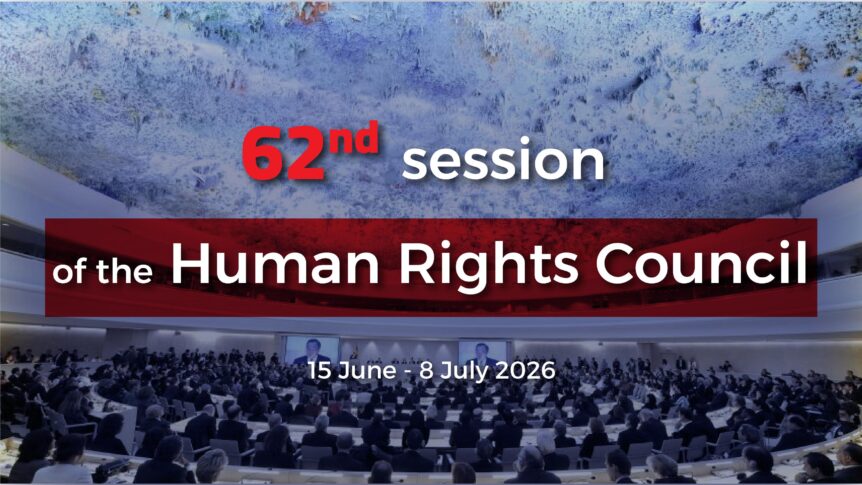
Despite sharply deteriorating human rights and humanitarian conditions across Arab countries, the 62nd session of the UN Human Rights Council, which ended yesterday 8 July, failed to engage in country-specific discussions on the Arab region. With Palestine and Sudan as exceptions, the region was effectively absent from the Council’s regular agenda.
The session, which coincides with the twentieth anniversary of the Council’s establishment, remained marked by narratives that failed to address the full picture of the Council’s work or the challenges facing today’s international order. Two decades on, the Council’s legitimacy arises from the active, safe, and unhindered participation of civil society, free from intimidation and reprisals, including through the reinstatement of hybrid modalities. Its legitimacy is likewise contingent upon meaningful and constructive cooperation by states with the Council and its mechanisms, including the Universal Periodic Review. The current financial constraints must not become a pretext for eroding either.
To mark the occasion, member states adopted by consensus a resolution recognizing the Council’s record in advancing international human rights law, responding to human rights emergencies, and holding states accountable for human rights violations. The resolution commended the Council’s investigative mechanisms, Special Procedures, Special Rapporteurs, and the Universal Periodic Review as among its most significant achievements, and recognized the vital contributions of civil society organizations, national human rights institutions, human rights defenders, and victims to the Council’s work over the past two decades. It also expressed concern over the growing attacks against mandate holders. It called on all states to cooperate fully with the Council’s mechanisms by responding to communications and facilitating country visits.
Opening the session on 15 June, the UN High Commissioner for Human Rights welcomed the ceasefire agreement between Iran and the United States, concluded only hours before the session commenced. At the same time, he highlighted the devastating consequences of the conflict for the region and its destructive impact on Lebanon. This latest conflict, he stressed, has once again demonstrated the failure of military solutions to resolve crises. The High Commissioner also warned against the failure to uphold ceasefire agreements, as has been the case in Gaza, where Israel has killed thousands of Palestinians since the ceasefire reached last October.
In her opening statement, the Deputy High Commissioner for Human Rights also underscored the surging of violence in Sudan, the underlying attacks against civilians and civilian infrastructure, and the use of sexual violence as a weapon of war. She called for an immediate end to attacks on civilians, urged international and regional actors to comply with the arms embargo on Darfur, and stressed the urgent need to end impunity.
In response to urgent calls from human rights organizations to address the situation in the city of El Obeid, in Sudan’s Kordofan region, the Council convened a special urgent session (on 3 July), during which the Office of the High Commissioner for Human Rights and the UN fact-finding mission on Sudan briefed member states on the latest developments on the ground. During the session, member states called for the immediate lifting of the siege on the city, the establishment of safe evacuation routes for civilians, and unimpeded access for life-saving humanitarian assistance. By consensus, the Council adopted a resolution mandating the Independent International Fact-Finding Mission for Sudan to conduct an urgent investigation into the situation in El Obeid and present its findings to the Council at its September session. The resolution failed, however, to identify the external actors involved in the violations, nor did it recommend referral to the UN Security Council of that the Fact-Finding Mission’s reports. The resolution also did not call for the expansion of the jurisdiction of the International Criminal Court to cover the whole of Sudan rather than Darfur alone.
For its part, the Cairo Institute for Human Rights Studies (CIHRS), together with the Sudanese Human Rights Monitor (SHRM), issued a joint statement calling on member states to take urgent measures to halt the flow of arms to the conflicting parties in Sudan and to press for an immediate ceasefire in El Obeid. The statement held the Rapid Support Forces and their regional backers responsible for the siege of the city and the grave harm inflicted on its civilian population, while also calling on the Sudanese Armed Forces to refrain from turning residential areas into military objectives or bases for military operations.
During the Council’s three-week session, UN human rights mechanisms presented a number of noteworthy reports addressing pressing developments and situations across the region. The UN Special Rapporteur on the human rights of internally displaced persons underscored in her report that 82.2 million people are living in catastrophic conditions due to displacement in conflict-affected areas. Sieges, the destruction of civilian infrastructure, the deterioration of healthcare services and the collapse of markets were underscored by the report. Evacuation orders in both Gaza and Sudan have triggered large-scale displacement and severe humanitarian crises, while humanitarian workers continue to face significant restrictions in accessing affected populations and delivering life-saving assistance.
During the interactive dialogue on the report, CIHRS also raised alarm over the situation of internally displaced persons in Lebanon, condemning Israel’s indiscriminate attacks on civilian infrastructure its continued denial of displaced persons’ right to return despite the ceasefire agreement reached in November 2024. CIHRS also drew attention to Isarel’s systematic policy of forced displacement in Gaza and the immense suffering it has inflicted on civilians—particularly women and children—in the absence of any meaningful accountability.
The UN Independent International Commission of Inquiry on the Occupied Palestinian Territory also presented a dedicated report during the session entitled “‘The essence of childhood has been destroyed’: Israel’s deliberate targeting of Palestinian children in the Occupied Palestinian Territory since 7 October 2023,” which harrowingly documents the brutality of the crimes perpetrated against Palestinian children, including indiscriminate killing, starvation, torture, forced displacement, and denial of access to healthcare and education.
In another report presented during the session, the UN Special Rapporteur on the rights to freedom of peaceful assembly and of association warned of the expansion of modern surveillance, spyware, and data collection technologies into a comprehensive system aimed at suppressing those and other rights. Human rights defenders, activists, and political dissidents are increasingly targeted for prosecution and imprisonment through the use of these technologies.
During the interactive dialogue, CIHRS emphasized the report’s salience to the Middle East and North Africa region, noting that it documents patterns of abuse against advocates and dissidents that have long been identified by civil society organizations in Egypt, Algeria, and Palestine. CIHRS called on states to prohibit the transfer of surveillance technologies to governments implicated in documented human rights violations, to incorporate the protection of the rights to freedom of peaceful assembly and of association as binding safeguards in all legislation governing cybercrime and digital technologies, and to close the legal loopholes that enable transnational digital repression to target human rights defenders wherever they are.
The session also saw the adoption of the recommendations relating to Lebanon’s human rights record under the Universal Periodic Review (UPR). In its statement, the CIHRS stressed that similar commitments had been made during Lebanon’s previous three UPR cycles, yet implementation on the ground has remained limited. While acknowledging that Lebanon is receiving these recommendations under exceptional circumstances—namely, Israeli attacks that have devastated much of southern Lebanon, resulting in widespread displacement amid an ongoing economic crisis—CIHRS emphasized that these conditions call for stronger international support and oversight, rather than reduced scrutiny of the implementation of UPR recommendations. The Institute further stressed that the Lebanese people deserve protection from external violence and the full enjoyment of their rights within their own country.
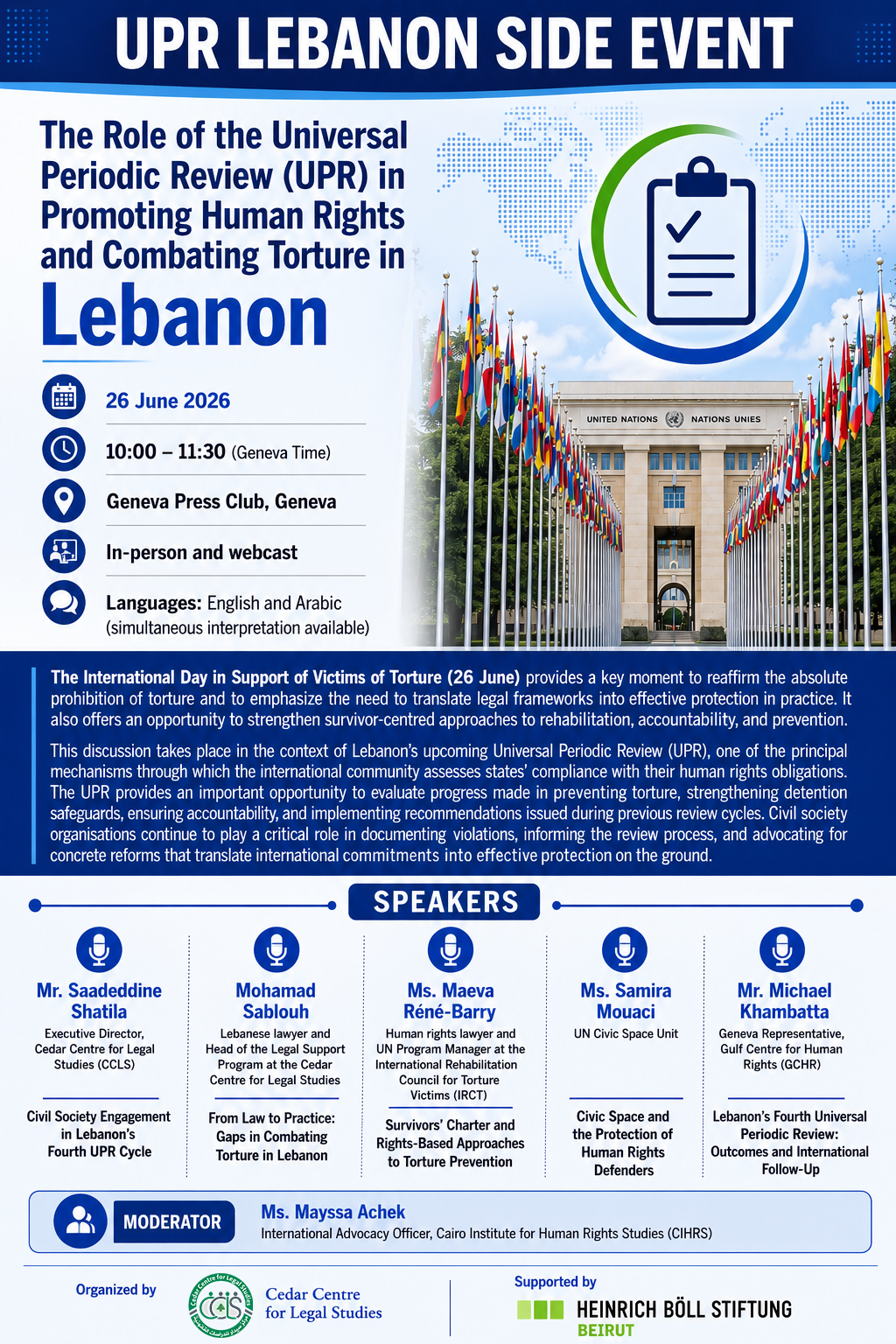
Coinciding with the International Day in Support of Victims of Torture (26 June), CIHRS participated in a public side event organized by the Cedar Centre for Legal Studies (CCLS) examining the persistent gap between Lebanon’s legal commitments and the reality of torture and ill-treatment in places of detention. The event brought together legal experts, UN officials, and civil society representatives to assess the implementation of Lebanon’s anti-torture legal framework, particularly Law No. 65 of 2017, in light of documented patterns of impunity, the systematic referral of torture complaints to military courts, and the failure to implement the procedural safeguards enshrined in Article 47 of the Code of Criminal Procedure. In this context, CIHRS highlighted the continued referral of torture cases to military courts, in violation of Lebanon’s Anti-Torture Law, thereby depriving victims of access to effective remedies.
With regard to the resolutions adopted during the session, the Cairo Institute for Human Rights Studies (CIHRS) welcomes the adoption of the resolution on the right to freedom of opinion and expression, which builds on the momentum generated by recent Council resolutions by strengthening language on the impact of transnational repression and mandating a comprehensive study on cross-border threats targeting the right to freedom of opinion and expression.
Amid a challenging international order, the UN liquidity crisis and related budget cuts pose a serious threat to the Council’s ability to fully deliver on the mandates agreed by member states. CIHRS therefore urges all UN member states to ensure support adequate, predictable, increased, and sustainable funding for the UN’s human rights pillar as a whole. In this regard, we welcome the recent decision by the General Assembly’s Fifth Committee to suspend the return of unspent cash, due largely to late payments by member states. While this decision may help mitigate the impact of the liquidity crisis, it does not relieve states of their obligation to pay their assessed contributions in full and on time.
Share this Post