
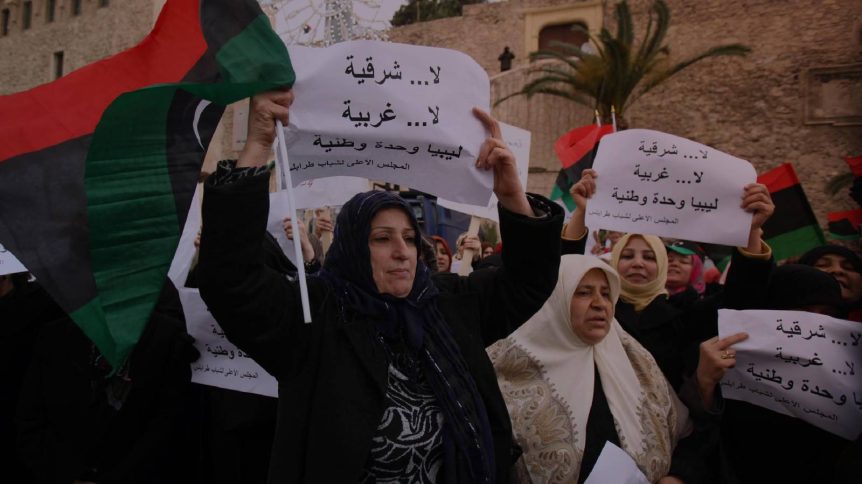
A Libyan Draft Law on the Protection of Women from Violence, introduced in November 2023 and currently awaiting parliamentary approval, marks an important normative step toward recognizing and combating violence against women and girls in Libya. If adopted, it would align Libya closely with international standards by defining violence broadly, criminalizing multiple forms of abuse, and creating mechanisms for protection and redress. On the occasion of the United Nations’ 16 Days of Activism against Gender-Based Violence (November 25 – December 10), the Libya Platform Coalition and the Cairo Institute for Human Rights Studies call on Parliament to adopt the draft law in earnest.
Yet we warn that, in a context of political fragmentation, militia dominance and a largely non-functioning justice system in Libya, even the most progressive law risks remaining purely symbolic unless accompanied by genuine structural reforms.
The proposed law sets out a comprehensive definition of violence that includes physical, psychological, sexual, economic, political and online abuse, as well as violence during conflict and displacement, in line with standards such as CEDAW and the UN Declaration on the Elimination of Violence against Women. The draft also contains a modern definition of consent, mandating that it must be free, conscious, continuous, and that it would be invalid if the woman is under 18, unconscious, under coercion, fear, abuse of power, or detention. Silence or not resisting is not considered as consent.
It recognises all women and girls as rights-holders and even extends the definition of ‘victim’ to those harmed while helping survivors. The text guarantees access to justice, legal aid, psychosocial support, shelters, and emergency health care— including in cases of rape— and allows courts to issue rapid protection orders at all stages of proceedings. It also mandates the creation of specialized police units, a dedicated public prosecution service and specialized judicial chambers, as well as a national committee and strategy to combat violence against women. Taken together, these features place the draft among the more advanced legislative initiatives in the region.
The draft law does have some shortcomings. While it provides for emergency contraception and treatment for sexually transmitted infections, it does not guarantee access to safe abortion for survivors of rape or incest, an increasingly recognised component of comprehensive health care. This is particularly important in Libya where abortion is prohibited and allowed only in cases where it is necessary to save the mother’s life. Nor does it directly repeal discriminatory provisions in existing laws, leaving family law and penal code provisions that undermine women’s equality intact. These gaps matter, but they are not the main obstacle to protecting women in Libya.
The broader landscape of lawlessness fundamentally undermines the potential impact of the draft. Libya remains fractured by competing authorities, militia control and a judiciary weakened by political interference, security threats and lack of resources. In such an environment, impunity prevails and few women can safely seek justice. Militia domination and parallel security structures mean that specialized police units may exist on paper but not in practice, or may be controlled by local powerbrokers. This dynamic was starkly illustrated by the armed assault on the Abu Salim Personal Status Court in Tripoli on 15 July 2025, when gunmen in armoured vehicles opened fire on the building, forcing proceedings to halt and terrorizing judges, staff and visitors.
This environment has also allowed political violence against women to flourish. The assassinations of journalist Nasib Karnafa in Sabha in May 2014, lawyer and human rights defender Salwa Bugaighis in Benghazi in June 2014, General National Congress member Fariha Al-Berkawi in Derna in July 2014, Intisar Al-Hassairi and her aunt in February 2015 and activist Hanan al-Barassi in 202 – all targeted after publicly denouncing the authorities-are emblematic of the risks faced by women who speak out. The most recent of these tragedies is the assassination of social media content creator Khansa Mohamed Abdulmajid on 21 November 2025, who was shot in the Janzour area of Tripoli. These cases reflect a wider political and social environment that is increasingly conducive to violence against women, where intimidation, repression, and the absence of accountability create fertile ground for further abuses.
Meanwhile, over the past two years, western and eastern authorities have increasingly used morality-based arguments to consolidate authoritarian control, particularly targeting women. For example, on 6 November 2024, the Tripoli-based Libya’s Minister of the Interior, who belongs to the UN-recognized Government of National Unity, announced plans to establish a ‘Morality Police’ and enforce mandatory veiling on women.
A paralyzed judiciary cannot deliver timely, impartial rulings or enforce protection orders, while pervasive insecurity and economic hardship discourage survivors from reporting abuse or leaving violent relationships. Fragmented state institutions further prevent consistent implementation: services and protections may exist in one region and be entirely absent in another.
In such conditions, no single law, however carefully drafted, can meaningfully protect women.
Libyan Parliament must address both the legal gaps in the draft and the broader environment of impunity. The law should guarantee comprehensive sexual and reproductive health care, including for survivors of sexual violence. It should include a clear, enforceable non-discrimination clause that ensures equal access to services for all women, including migrants, refugees, internally displaced women and women with disabilities.
At the structural level, Libya must cultivate the rule of law by reunifying and protecting the judiciary from political and armed interference, providing adequate security and resources for judicial actors, and conducting security sector reform, including the demilitarization of law enforcement under genuine civilian oversight. Crucially, the safety and freedom of women human rights defenders—including activists, lawyers, counsellors and journalists—must be guaranteed, as they are central to supporting survivors and demanding accountability. Without all of these comprehensive reforms, the law, even if adopted, will remain a symbol of intent rather than a tool for real change.
Share this Post