
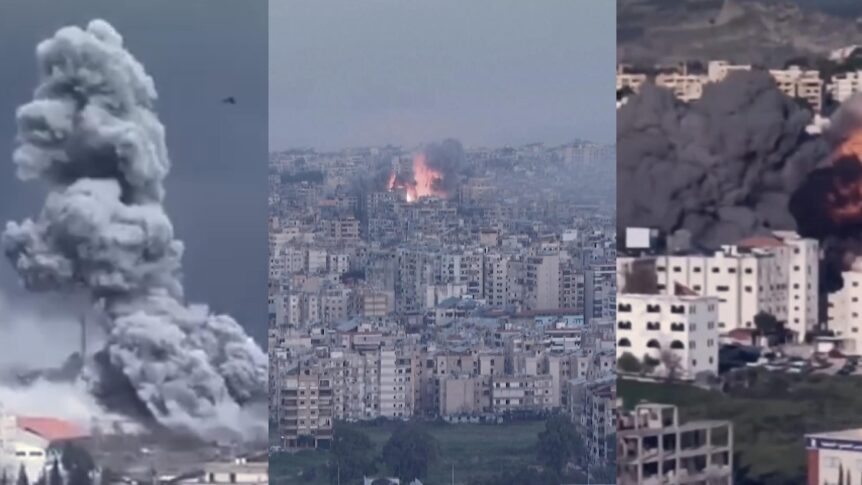
The US–Israel attack against Iran on 28 February 2026 and its regional spillover is plunging the Middle East into a new and devastating cycle of violence. Unless the international community acts decisively and urgently to protect civilians and halt further escalation, the consequences will be catastrophic for the people of the region, and for international peace and stability.
The Cairo Institute for Human Rights Studies (CIHRS) calls on the United Nations to urgently lead a comprehensive peace and security initiative to prevent further escalation and address the structural drivers of instability in the region. Such an initiative must prioritize ending Israel’s illegal occupation of Palestinian, Lebanese, and Syrian territories and putting in place concrete measures to halt repeated acts of military aggression. It must also confront Iran’s regional military expansionism, including its support for armed proxy groups in Lebanon, Syria, Iraq, and Yemen. At the same time, the international community should renew its commitment to nuclear disarmament and ensure full, transparent compliance with the Nuclear Non-Proliferation Treaty by Israel, Iran, and all states in the region.
In the immediate term, all parties to the conflict must respect international humanitarian law and the UN Charter. This includes ending acts of military aggression, refraining from indiscriminate attacks against civilians and civilian infrastructure, and upholding their obligations under international law.
Ultimately, any sustainable path to peace must center democratic governance and civic freedoms, ensuring that the voices and aspirations of the region’s peoples take precedence over militarized power struggles.
This war unfolds against a backdrop of systemic and entrenched impunity for all principal actors, following years of grave and repeated violations of international law. Israel and the United States have faced no meaningful accountability for serious breaches of international human rights and humanitarian law, including the genocide in Gaza.
At the same time, Iran’s pursuit of regional dominance through military intervention and proxy networks has undermined prospects for peace and democratic governance across the Arab region. In Syria, its sustained support for the Assad regime facilitated mass atrocities and the forced displacement of millions of Syrians and Palestinians. Some of the Gulf States currently suffering indiscriminate attacks by Iran have likewise been implicated in serious violations of international law, including in Yemen and Sudan.
Civilian populations in the region are once again paying the highest price. In Lebanon, Hezbollah and Israel are putting civilians at risk by making the state a battleground for proxy confrontation between the US–Israel alliance and Iran. In a country already devastated by previous Israeli offensives, this new escalation threatens to plunge Lebanon into further instability and violence, while undermining an already fragile political process aimed at restoring state authority and consolidating control over armed groups.
In Gaza, Israel continues its devastating military campaign, marked by repeated violations of the fragile ceasefire and severe restrictions on humanitarian aid. Prior to the confrontation with Iran, the United States had announced proposals to reshape Palestine, including plans involving large-scale displacement of Palestinians into camps or through so-called “voluntary” resettlement to third countries, while transforming Gaza into a militarized and commercial zone. Following the escalation with Iran, Israel closed all border crossings into Gaza, further restricting access to essential supplies. Given Gaza’s near-total dependence on external aid, these closures have had devastating humanitarian consequences.
At the same time, the war coincides with renewed domestic repression in Iran. Since January 2026, Iranian authorities have violently cracked down on protesters demanding economic justice and political freedoms. According to several NGOs and to the UN, the death toll from the latest wave of repression has reached at least 3,000. The US–Israel attack on Iran—framed in rhetoric about supporting the Iranian people—has instead compounded their suffering. According to the Iranian Red Crescent, at least 555 people have been killed in the recent strikes, including victims of alleged attacks on a girls’ school and a hospital.
CIHRS unequivocally rejects any foreign military intervention aimed at regime change. Military escalation will not deliver democracy or human rights. At the same time, CIHRS reaffirms its unwavering support for the democratic aspirations of the people of Iran and of all peoples across the region.
The protection of civilians must not be subordinated to geopolitical rivalries or hegemonic calculations. Ending impunity, upholding international law, and centering the rights and dignity of all people in the region are the only sustainable paths toward peace and stability.
Share this Post