
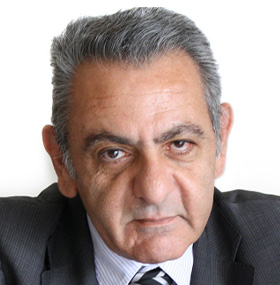
Hazem Saghieh
A Lebanese writer and political commentator, Hazem Saghieh writes for Asharq Alawsat. He is the author of several books on politics and political culture in the Middle East.
Liberalism, and other modern schools of thought of European origin, pose difficult questions for most non-European societies, including Arab ones. Scant attention to the problems of cultural grafting and adaptation often leads liberals, as it did nationalists and Marxists before them, into a degree of oversimplification and expedience. With the exception of Egypt and Morocco, Arab countries may lack a foundational consensus around the nation, the state, and the people. Indeed, pre-state and sub-state affiliations generally hold sway. It has been widely though wrongly assumed (whether consciously or unconsciously), that this formative weakness can be overcome by defining nationalism as hostility towards the coloniser, the imperialist, or the foreigner. This antagonistic approach has only exacerbated the inherent weakness of nationalism while adding another dimension to the conflict over identity and its meaning.
This tendency was compounded by the rise of Islamist movements, which dealt an unprecedented blow to national unity, including to its strongest iteration: Egyptian national unity. Between the intrusion of violence into public life and growing interference in private life, the commonalities uniting the single national community have become hypothetical propositions with little emotional resonance or practical evidence of their existence. Thus, consensus—which was scarce in any case—has been further eroded, just as the distance between one group and another within nominal nations has widened.
In contrast, if we accept John Locke as the father of liberalism, we know that liberalism in the West was born within the context of the establishment of consensuses that had been either obstructed or destroyed by civil war. John Locke himself was a leading proponent of tolerance, as expressed in his famed epistle. In our societies we can say, then – with deep regret – that liberalism is not on the agenda of our history. For us, it is more an intellectual and psychological sensibility, which is also true of nationalism, socialism, and the other products of Western modernity.
The issue facing the vast majority of our societies is the formation of the nation and the state itself, and the construction of foundational consensuses and myths that serve this formation. If experience has proven this impossible, the principal task is to reconsider the existing forms of the social contract in countries that have not yet attained the status of nation-states. And while unification or partition may be attainable, whether in liberal or authoritarian, dictatorial, or quasi-totalitarian frameworks, the fundamental issue remains unification or partition, not the political or ideological framework in which it will be realised.
There is another issue that is a corollary of the first: Liberalism is a limitation or a constraint on the state insofar as it demands an expansion of freedom. This, ultimately, is the core definition of liberalism. In many of our societies that lack a state, however, the state itself is needed, if not desired. Of course, by state here I do not mean the instruments of repression and authority, although these are an integral part of every state. Rather, I mean primarily the entity that enforces the law, protects citizens’ lives and property, and serves as an arbiter, preventing those with economic and political power from exploiting the weak.
In our societies, the tendency to interfere to curtail freedom is not limited to the state. Where the state is weak and fragmented—such as my country Lebanon and other countries ravaged by civil wars—civil society plays this role more effectively. When it comes to individual, cultural, religious, and gender freedoms, it is no exaggeration to say that the state is far more compassionate and tolerant than the fanatical, militant forces in civil society. This is not altered by the fact that the state apparatus may, here or there, be compelled to collude or align with a segment of civil society.
This presents a difficult, potentially politically costly undertaking to those with a liberal bent: reconciling and balancing a critique of the state with a critique of society or opposing statism without weakening the state, while moreover resisting populist tendencies without detaching oneself from the people and the broader political milieu.
Moreover, as Arab liberals define their sensibility and stance, they face a crucial issue or an urgent question: Are they driven by geopolitical considerations that prioritise confronting powerful totalitarian regimes that threaten freedom, such as Soviet Russia yesterday and Khomeini’s Iran today? And, in consequence, is it their position to defend the policies and interests of Western democratic and liberal states, as was the case with prominent liberals like Raymond Aron and Isaiah Berlin? Or does their stance prioritise values, such as opposing oppressive regimes and social superstitions, and so advocates for progressive changes in the status of women and greater social justice? This reflects the position of American left-wing liberalism and, to some extent, Hannah Arendt.
It is true that both schools of thought are ultimately connected. The first school may see the removal of these regimes as a path to the triumph of the other’s values, while the second may see the struggle for values as a prelude to the establishment of alternative systems. Nevertheless, choosing a focus remains critical, especially within the political processes unfolding in our daily lives. The geopolitically minded may tolerate neoliberal economics or regimes whose position in regional or international alignments is their only redeeming quality. By the same token, values-oriented liberals may be carried away by a legalistic, rights-based approach that dulls their political sensibility and leads them to indulge the freedom of groups that threaten democracy.
The liberal mindset raises another question, one that is part of its very foundation or underlying structure: Is liberalism’s primary enemy fascism, as an unbridled form of statism, or is it communism, which is also an unbridled form of statism?
Here, too, it will always be possible to take a negative stance towards both, though the question of priority remains. I believe that communism and its offshoots allow for a distinction between their Enlightenment and totalitarian aspects, while fascism can only be dealt with as a unified whole that combines opposition to the Enlightenment, democracy, and culture.
Since liberalism is among the least ideological of ideologies and among the least averse to eclecticism, the liberal sensibility is now called upon to broaden its familiarity with less ideological ideologies such as empiricism, utilitarianism, and pragmatism, as well as to devise a formula for some kind of synthesis with theories of social justice, particularly democratic socialism. In addition to improving its overall political position, this will allow it to expose the incoherence and illusoriness of rigid ideological systems that, undeterred by numerous, mounting countervailing life experiences, continue to march forward with their own interpretations of the world and history.
In all cases, the greatest threat to liberalism today is posed by nationalist populism, personified by Donald Trump, which threatens to undermine the liberal ideal at its very source and origin in the West, not to mention destroy already fragile liberal sensibilities outside the advanced industrial countries. This recognition entails several intellectual and practical tasks.
Published on : 26/02/2026
This paper has been translated from Arabic.
This paper was prepared and presented as part of the Regional Forum of the Human Rights Movement, organized by the Cairo Institute for Human Rights Studies (CIHRS), in its 28th session, November 2025.
Share this Post
Any views expressed in this publication are the views of the authors and not necessarily the views of the Cairo Institute for Human Rights Studies.
You may also like
Political Dominance – When Economic Performance Takes a Back Seat
Ishac Diwan
Arab Limited Access Orders: Can They be Reformed?
Dr. Robert Springborg
Egypt’s Cultural Elite: Guardians of Stagnation
Ezzedine C. Fishere
Perceptions of Palestinian Politics and Struggle: The Case of Al-Aqsa Flood and the Israeli War of Genocide
Majed Kayali
Political Transition in Post-Assad Syria: An Analysis of Discourses
Dr. Sari Hanafi
Who Decides the Foundations of the New Syria? Who Is Sovereign?
Yasin Alhaj Saleh
Which New Middle East? The End of the Nation-State and the Federal Option
Morris Ayek
The New Balance of Power in the Middle East and its Implications for the Nation-State in the Mashreq
Dr. Marwan Kabalan
28th Regional Forum of the Human Rights Movement
Toward New Paths to Reform
Paris: 22 – 23 November 2025
Hazem Saghieh
A Lebanese writer and political commentator, Hazem Saghieh writes for Asharq Alawsat. He is the author of several books on politics and political culture in the Middle East.
Subscribe to the newsletter