
Ishac Diwan
Professor of the Practice of Economics at the American University of Beirut since 2024 and serves as Research Director of the Finance for Development Lab at the Paris School of Economics. His research focuses on the political economy of the Middle East and international financial matters.
This note explores how political settlements in the Middle East, often dominated by autocratic regimes, are sustained by rents that support the security state, and a system of crony capitalism.
Historical roots.
After independence, many Middle Eastern states pursued ambitious state-led projects of modernization. They adopted inward-looking strategies of import substitution and social transformation—initially exemplified by Turkey, and later by Egypt and Iran. These models were most radically emulated by the revolutionary regimes of Iraq, Syria, Algeria, and Libya. Elements of this developmental model were also visible, albeit more conservatively, in the trajectories of Jordan, Morocco, Lebanon, and the Gulf monarchies, where private economic activity retained a stronger role.
By the 1980s and 1990s, the limits of the import substitution model had become apparent. Its inefficiencies clashed with the forces of globalization and the global turn toward neoliberalism, prompting waves of economic liberalization. Yet, unlike other regions that coupled market reform with political opening—the so-called “third wave” of democratization—the Middle East liberalized its economies without liberalizing its politics.
This produced unbalanced forms of capitalism: segmented between insiders and outsiders, characterized by a protected crony sector shielded from competition, a sprawling informal economy, and a “missing middle.” The result was tepid growth, limited job creation, and mounting social frustration—especially among educated youth facing rising aspirations but declining opportunities. These economic grievances were compounded by the systematic repression of political voice.
To note: East Asia retained strong developmental states with limited political liberalization. Some MENA states (Turkey, to some extent Morocco and Jordan) did experiment with partial political openings, though these were later reversed.
Rents as Pillars of Autocracy
- Rents (like oil revenues or foreign aid) allow autocrats to maintain power by securing loyalty from key elites and using repression to quell opposition. This keeps the political system stable even if the economy is underperforming.
- Crony Capitalism as regime insurance: the deliberate reservation of economic space for regime-connected firms serves as a political insurance mechanism. It prevents the emergence of an independent business class, while creating an economic elite whose survival is tightly bound to that of the regime—one willing to defend it at all costs.
- The politics of limited rents: In the absence of substantial external rents, autocrats must rely more heavily on the domestic private sector to generate jobs and fiscal revenues. In such contexts, cronies must also perform economically, not merely serve politically. Political tensions then shift from managing popular unrest to managing competing economic elites.
- Not all rents are exogenous (oil, aid). Some are endogenous political constructs, e.g., monopoly rights, public procurement, or financial rents.
Rents and Regime Type
- Natural Resource Rents: Oil and gas in the GCC, Iraq, Libya, Egypt, Sudan, Algeria, Iran, Israel, Syria, and Yemen; phosphates in Morocco and Tunisia; and Suez Canal revenues in Egypt.
- Geopolitical Rents: Strategic rents derived from alignment with Western powers, hosting refugees, or mediating conflicts (Egypt, Jordan, Lebanon, Syria, Israel), and, more recently, North African cooperation with the EU to contain migration.
- Internal Rents: These function like taxes but are often more distortive—arising from crony exchanges, informal markets, contraband, financialization (Lebanon), sanctions (Iran), and war economies (Syria, Yemen, Libya, Sudan).
- “Poor” vs. “Rich” Rentierism (see Figure 1):
- Poor rentierism channels limited external rents primarily to the security sector, reinforcing repression and shrinking productive activity—consistent with Douglas North’s “violence trap.”
- Rich rentierism, as practiced in the GCC, is less antagonistic to private enterprise and economic growth. Generous rent distribution and the high cost of rebellion reduce the incentives for insurrection.
- For perspective: rich rentierism can mobilize roughly $50,000 per national, compared to less than $5,000 in poor rentier systems.
Impact of Cronyism on Economic Performance
- Static Inefficiencies: Misallocation of resources (loyalty rewarded over merit, capital favoring connected over productive firms); misuse of public funds through corruption and inflated procurement.
- Dynamic Inefficiencies: Limited competition dampens innovation and creative destruction; protection of inefficient allies perpetuates informality and low productivity; poor policy choices—such as protectionism, currency overvaluation, and low social spending—further weaken growth.
- Macroeconomic Volatility: Exposure to “Dutch Disease” effects and the instability of external rents (resource or geopolitical) create income fluctuations and fiscal fragility.
- Governance Erosion: Rent-seeking corrodes institutions, breeds corruption, and undermines social trust.
Impact of Economic Structures on Politics
- The economic structure in many Middle Eastern states is designed to preserve the power of the ruling elite. Historically, this was modeled on the Ottoman system, which kept local elites weak and centralized control strong.
- Economic systems are structured to preserve the political status quo—producing “presidents for life” whose overriding objective is to preempt reformist coalitions.
- In contemporary mid-rent regimes, the dominance of the security state and narrow clientelism remain defining features.
Limits and Variations of the Argument
- The framework applies most clearly to medium-size (per capita) oil producers such as Iraq, Iran, Algeria, and—partially—Yemen and Syria, where external resource rents have functioned as a curse.
- It also holds in high-rent per capita contexts, though with different dynamics: high rents temper rebellion and sustain social contracts (e.g., Saudi Arabia, albeit as a borderline case straddling rich and poor rentierism, as its vast rents are diluted by a large national population.
- The rentier argument is weaker in the low-rent regimes of Tunisia and Morocco. With limited external rents (e.g., phosphates, tourism, remittances), these regimes depend more on domestic private sector performance. This introduces greater variability among autocracies as some must actively manage economic elites rather than merely co-opt them through rents.
- Weak performance in such cases has periodically triggered social mobilization, posing real threats to regime stability, as these regimes lack the ability to finance a security apparatus dedicated to regime survival.
- Turkey illustrates the potential of a low-rent regime to combine growth and legitimacy—at least until the mid-2010s, when its growth model began to erode, and it began to shift toward “competitive crony capitalism.”
In sum, rents help sustain autocratic rule in the Middle East by maintaining loyalty and quelling dissent. However, this model also stifles economic growth and creates systemic instability, especially in rent-poor countries.
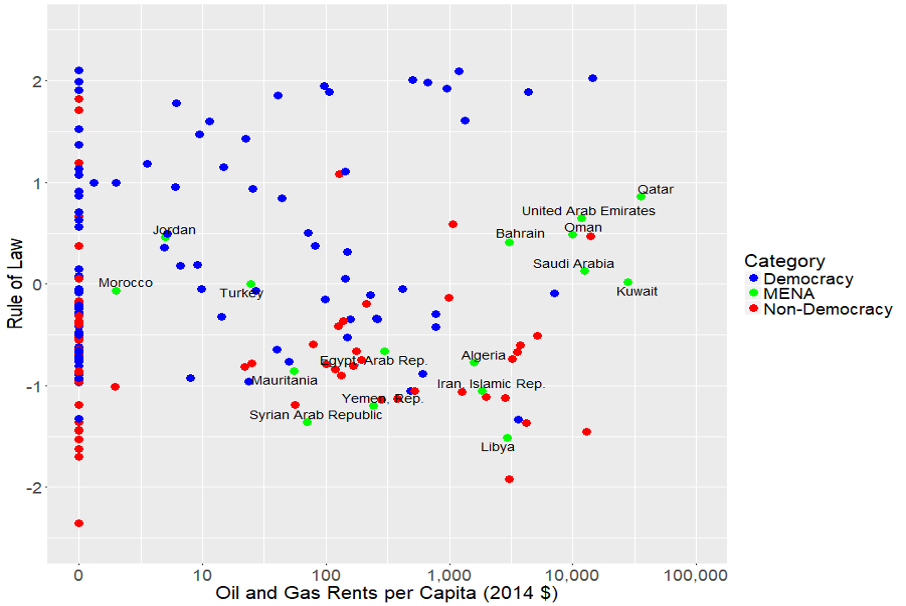
Figure 1. The relation between Rule of Law and Rents resembles a U-curve
Published on : 12/03/2026
This paper was prepared and presented as part of the Regional Forum of the Human Rights Movement, organized by the Cairo Institute for Human Rights Studies (CIHRS), in its 28th session, November 2025.
Share this Post
Any views expressed in this publication are the views of the authors and not necessarily the views of the Cairo Institute for Human Rights Studies.
You may also like
Arab Limited Access Orders: Can They be Reformed?
Dr. Robert Springborg
Liberal Questions about the Current Arab Reality
Hazem Saghieh
Egypt’s Cultural Elite: Guardians of Stagnation
Ezzedine C. Fishere
Perceptions of Palestinian Politics and Struggle: The Case of Al-Aqsa Flood and the Israeli War of Genocide
Majed Kayali
Political Transition in Post-Assad Syria: An Analysis of Discourses
Dr. Sari Hanafi
Who Decides the Foundations of the New Syria? Who Is Sovereign?
Yasin Alhaj Saleh
Which New Middle East? The End of the Nation-State and the Federal Option
Morris Ayek
The New Balance of Power in the Middle East and its Implications for the Nation-State in the Mashreq
Dr. Marwan Kabalan
28th Regional Forum of the Human Rights Movement
Toward New Paths to Reform
Paris: 22 – 23 November 2025
Ishac Diwan
Professor of the Practice of Economics at the American University of Beirut since 2024 and serves as Research Director of the Finance for Development Lab at the Paris School of Economics. His research focuses on the political economy of the Middle East and international financial matters.
Subscribe to the newsletter