
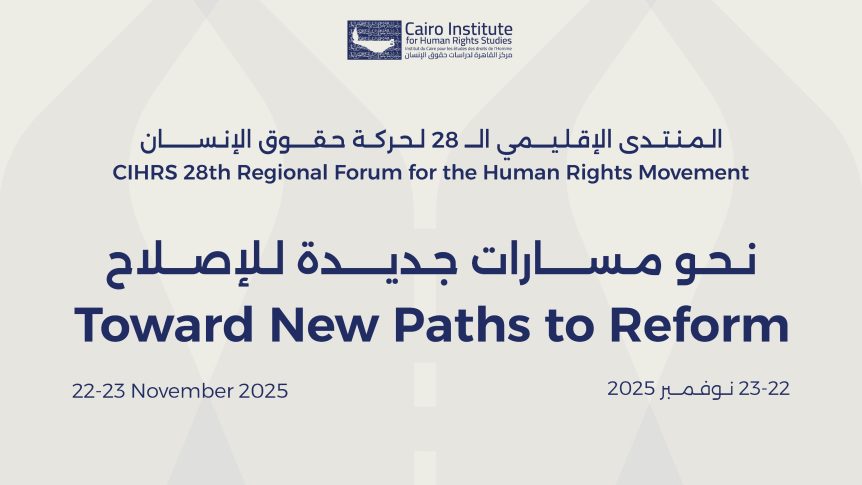
Conclusions of CIHRS 28th Regional Forum for the Human Rights Movement
Under the title ‘Toward New Paths to Reform’, the Cairo Institute for Human Rights Studies (CIHRS) organised the 28th Regional Forum of the Human Rights Movement on 22–23 November 2025 in Paris, France. Fifty human rights defenders and academics from eight Arab countries participated - from Algeria, Egypt, Lebanon, Morocco, Palestine, Syria, Iraq, and Tunisia - in addition to participants from the United States and Europe.
The Forum convened at a historically critical moment for the Arab region, one open to many possibilities. The genocide in Palestine and Sudan, and the protracted Russian invasion of Ukraine, have not only exposed the hollowness of the international community’s ability to intervene meaningfully, but also the complicity and moral collapse of many Arab governments. At the same time, popular solidarity with the Palestinian people across the region has been systematically emptied of political agency; societies have been denied the capacity to translate their outrage into action, as was the case with many Western peoples. This condition, where peoples are stripped of their political rights while regimes instrumentalise the Palestinian cause, was a central theme dominating the Forum’s discussions.
This regional paralysis coincides with other seismic shifts. The collapse of the Assad regime in Syria is ushering in a new, uncertain phase in the Mashreq. Egypt is witnessing tensions within the ruling circle, Tunisia a newfound threshold of repression, and Sudan an unaddressed genocide with direct involvement of regional actors and Arab governments. Contradicting common narratives, several participants insisted that the existential threats to the nation-state model in states like Syria, Sudan, Iraq, Yemen and Libya stem largely from the actions and rivalries of Arab and regional powers themselves.
A recurring question in the Forum’s history has been: what should human rights defenders and civil society actors do? Participants recalled earlier calls for democratic reform in the late 1990s and mid-2000s that went unheeded. The failures of those moments, and the regional political elites’ inability to generate a durable political opening, contribute heavily to today’s unravelling.
Structural Weaknesses of (Political) Liberalism and the ‘Death of Politics’
Participants devoted considerable attention to the crisis of political liberalism and the deterioration of political culture across the region. Political movements have long struggled with deep structural weaknesses: a historical rejection of liberal values by postcolonial nationalist movements, the rise of political Islam as an alternative imagination, and the inability of liberal actors to balance critique of authoritarian states with critique of societal conservatism.
The Forum emphasised that the region is witnessing what several participants called the ‘death of politics’: party systems reduced to sectarian shells, public life ossified by authoritarianism, ideological rigidity, and lack of imagination, while younger generations are chased away from formal political engagement. Political elites often display what some participants called ‘schizophrenia’: democratic discourse coupled with reactionary or exclusionary practices.
Some participants stressed the urgent need to rebuild theoretical tools capable of making sense of the region’s transformations. Meaningful intellectual production from the region is thin, and without new frameworks, societies cannot diagnose their crises or build coalitions for reform. The absence of such frameworks has contributed to repeated cycles of political failure, including the inability to capitalise on earlier openings for democratic change.
Discussions repeatedly returned to the way Arab regimes manipulate the Palestinian cause to justify repression, suppress dissent, and delegitimise demands for reform. The genocide in Gaza deepened this contradiction: it unleashed combative political discourse across the region, yet this discursive energy has not translated into organised political action for internal liberation.
The core reason, participants argued, is the erosion of freedom. Postcolonial Arab states are not accountable to citizens, but subjects without citizenship rights. There can be no political participation, no accountability, and no capacity to generate collective strategies, even in moments of regional catastrophe. This political void is noticeable not only in states like Egypt, Tunisia, Iraq, and across the Levant, but also in Palestine, even two years since the war of genocide started.
Economic Structures, Rentierism, and the Authoritarian Order
Economic discussions highlighted the central role of rent (whether oil rents, geopolitical rents, or institutional rents) in sustaining authoritarianism. Mid-rent states in particular face a severe structural crisis: weak economic performance, fragile institutions, and deepening inequality. These states are squeezed between the assertive rise of Gulf economies and the collapse of low-rent states like Syria, Yemen, Sudan, and Lebanon.
The Forum explored how ‘limited-access orders’ restrict economic opportunity, materially empower regime insiders, and prevent the emergence of broad middle classes capable of pushing for reform. Crucially, discussions linked these economic structures to political stagnation: states that do not emancipate economic actors cannot emancipate politically. The collapse of many Arab economic models is inseparable from the collapse of their political models.
Shifting Regional Power and the Fragmentation of the Middle East
Participants traced dramatic transformations in regional power dynamics. Gulf states have become more assertive and influential, not only through wealth but through shaping political orders in weaker states. Traditional centres of power, like Egypt, have lost their regional weight due to economic underperformance and loss of political legitimacy. Iran’s political ambitions are being recalibrated, while Turkey oscillates between ambition and constraint. These shifts complicate the work of human rights defenders, who lack a clear strategy to respond to the growing influence of non-democratic regional hegemons. The international order, already undergoing severe erosion, offers little support, as multilateral systems continue to convene without consequence.
Collapse of the Nation-State and the Crisis of Imagination in the Levant
A central theme was the implosion of the nation-state in Syria, Iraq, and Lebanon. Ethnic and sectarian tensions, often portrayed as primordial, are instead understood as products of ideologies and policies, amplified by the architecture of the postcolonial nation-state and the blessing of influential political elites. Participants described how decades of authoritarian centralisation, coupled with war and external intervention, accelerated the fragmentation of identity and authority. Sectarian and ethnic identities have become political containers in the absence of national politics and cohesion.
The Forum debated the potential of federalism as a structural remedy. Supporters argued that it could manage diversity, decentralise authority, and create space for marginalised communities. Critics warned that federalism may solidify divisions rather than resolve them, especially in contexts where sectarianization has been intentionally engineered. While multiple trajectories for Syria’s future governance were explored, all those scenarios shared a troubling feature: the absence of an effective national, democratic opposition. Syria’s opposition forces have been decimated by decades of brutal authoritarianism and conflict. Even where new opposition forces emerge, some replicate the sectarian logics of the authorities they oppose.
Stagnant Elites in Egypt, Palestine, and the Wider Region
Another recurring theme was the generational and structural failure of Arab elites. Whether political, cultural, or economic, elites remain trapped in reproduction cycles that stifle innovation. In Egypt, elites have been unable to generate a coherent political vision after 2011, nor have they developed initiatives of self-critique. Meanwhile the Palestinian Authority has come to resemble an agent of the Israeli occupation. The Palestinian national movement in Gaza and the West Bank has suffered from fragmentation and an inability to agree on an effective strategy, resulting in deep crisis. Across the region, including in Palestine, elites oscillate between radical slogans and practices that do not rise up to the challenge, unable to break with authoritarian frameworks or look to the future.
The Forum ended with a sober recognition: the Arab world stands at the intersection of authoritarian resilience, societal fragmentation, economic decay, and international indifference. As such, the Arab Spring was a false dawn not only because of regimes’ brutality but also because political and cultural elites lacked a shared diagnosis and roadmap. The task now is to renew the political culture, rethink frameworks, empower citizens, and transform discussion into action. Without renewed political imagination, the region risks remaining mired in cycles of collapse and reaction without the political tools required to break free.
Forum Papers
Ishac Diwan
Dr. Robert Springborg
Hazem Saghieh
Ezzedine C. Fishere
Majed Kayali
Dr. Sari Hanafi
Yasin Alhaj Saleh
Morris Ayek
Dr. Marwan Kabalan
Share this Post