
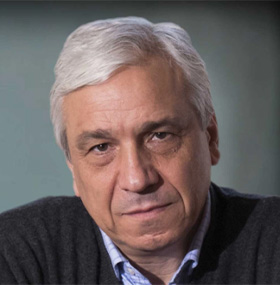
Yasin Alhaj Saleh
Syrian writer and former political prisoner, and a founder and regular contributor to Al-Jumhuriya magazine.
As we approach a year on the fall of the once assumed eternal Assad regime, an urgent question is: Who decides what is the best foundation for a new Syrian political order? Is it he who liberates, as the supporters of the new Syrian government put it shortly after the old regime’s ouster? Or is it the case that no single force can decide, and the matter will be determined by the long, complex, and costly process that led to political change in Syria? Or is the correct decision to partition Syria, given the two waves of massacres seen within months of the regime’s fall and the apparent continuation of the civil war? The question boils down to who is sovereign, if we define sovereignty as the power to establish a new beginning or order (and not as suspending the law and declaring a state of exception, as Carl Schmitt saw it)?
There are two or three answers to this tacit question now circulating in Syria. The first, as I just mentioned, is that whoever liberates is the decision-maker. That is, Ahmed al-Sharaa and a small group around him, or Hayat Tahrir al-Sham, which he led, or the armed Sunni forces that toppled the Assad regime are the ones who will determine the foundations of the new Syria; it is they who hold sovereignty and a final say on the matter. And these people are indeed proceeding to concentrate de facto power in their hands, though they exhibit some measure of rhetorical moderation. The political structure they are creating is an extremist one that belies their discursive moderation. For nearly a year, there has been no public process set in motion that bespeaks an effort to build non-sectarian political structures. From the Victory Conference to the National Dialogue to the constitutional declaration to the formation of the government, all of this points to a personalised, authoritarian regime that prioritises its own security and underscores Ahmed al-Sharaa’s role as an unrivalled leader.
A second response to the question advocates for the overthrow of the current regime, relying on non-Sunni armed civil forces and possibly external support. It may entail a call for partition or to flee the country in any way possible, the prevailing sentiment being: Run, save yourselves, for Syria has fallen into the grip of fascists and terrorists who will not stop with killing Alawites and Druze! From this perspective, any assistance offered against these people by any party is good, including by Israel. Some people giving this response were regime opponents, driven to call for the overthrow of the current government by the massacres of Alawites and Druze, just as the massacres perpetrated by the Assad regime led to widespread defections in the first two years of the Syrian conflict. Others giving this response, however, were lukewarm in their opposition to the Assad regime or even loyal to it.
A third response holds that the basis of the new Syria is determined, objectively, by the opponent against whom the Syrian revolution rose up, as well as by the broad revolutionary spectrum seen in the early days of the Syrian revolution before the Assad regime unleashed genocidal violence and called in foreign backers for support, which sent the revolution down complex, nihilistic trajectories and denationalised the conflict. If the revolution was launched against a tyrannical regime that stripped the ruled of their political rights and citizenship and beset the state from all sides, stripping it of all semblance of nationhood, then the foundation of the new Syria must be the opposite of this: it should resolve the crisis of citizenship and nationalism that has plagued Syria for decades and, consequently, involve the establishment of inclusive governance structures in which diverse Syrians participate as equal citizens in a state of law, based on political pluralism and regular, free, multi-candidate elections. Those who favour this response are mostly opponents of the Assad regime who rejoiced at its downfall, but this viewpoint may also be shared by a diverse spectrum of Syrian patriots who are loathe to see the rise of sectarian and ethnic ties at the expense of Syrian patriotism; some of them may have occupied a grey area in the long years of the Syrian conflict.
That a diverse array of people support the change that occurred nearly a year ago does not mean they support the decisions of the new people in charge and their methods of governance, which are haphazard, betray a tendency to concentrate power on a communal basis, and have already caused two national catastrophes in the coastal region and in Sweida. This makes the current regime more of an extension of the Assad era rather than a radical break with it. Their modes of governance have also undermined the spirit of Syrian patriotism in favour of sectarian and ethnic divisions. The inclusive, democratic vision of a new Syria is a continuation of the struggle against Assad’s rule, and it can take advantage of the broad political ferment triggered by the regime’s fall and the spaces for expression and assembly now existing in the country.
As is apparent, the author leans towards the third answer, which grows out of a recognition of the objective foundations for envisioning a new Syria. This viewpoint does not acknowledge a rupture between 8 December and what came before; it claims neither that we are witnessing a one-of-a-kind liberation or that Syria has fallen under the sway of fascism and terrorism. Moreover, this response grows out of a view of the political landscape and the state itself as a space of engagement among diverse actors, ideas, and social forces, from within and outside it, and from in and out the country as well. The state is not impervious to Syrians’ diverse initiatives and actions. This is the true face of Syria today, despite the two blows it sustained in March and then in July.
The first and second responses are alike in their polarising tendency, and their hostility to and recrimination of others, which makes any real discussion impossible, not only among these two camps, but also with those who lean toward the third answer, which is repelled by polarisation. The difference between the first two answers can perhaps be summed up in the question implicit in them, harsh and caustic as it is: What’s your favourite massacre? Those loyal to the current regime deny, minimise, or justify its massacres of Alawites and Druze by pointing to previous massacres; those opposed to the current regime focus their attention on the current massacres as if they have no history. The correct answer is that there are no favourite massacres; all of them are reprehensible crimes. We should insist that the current authority apologise for them and work to redress the harm while pursuing transitional justice with greater seriousness than it currently does in order to bring justice to the victims of previous atrocities.
In part, the stance one takes is a matter of perspective, both temporal and spatial. Syrian time has changed dramatically, representing the greatest event in the lives of most living Syrians. Syria as a space has changed dramatically as well: more than thirty per cent of Syrians now have the previously inconceivable option of returning to the country.
The longer temporal perspective means viewing the current Syrian moment as a part of the preceding Assad era and the entirety of Syrian history. Those in power who consider their rule an entirely new beginning and reject what came before are just as mistaken as those who reject this beginning and see no logic in it.
Similarly, the broad spatial perspective balances seeing things up close with an appropriate critical distance, which requires living in the country or, at the very least, visiting and attempting to gain insight. This would, first of all, give one a sense of the countless details that constitute the fabric of people’s lives, including political actors, and, secondly, de-dramatise events that are being cast as either an epic story of liberation or unmitigated evil. This seems like an obvious epistemic requirement, but many people—the most dramatic who call on us to flee, save ourselves, emigrate, and so on—willingly overlook it.
Others necessarily miss this point—namely, those who have been victims of massacres and humiliation, whom we should not expect to maintain a critical distance. Atrocities eliminate distance, and when you lose family and loved ones, you have every right to work against those who caused it. This is an obvious moral demand that should escape no one, and it is the same demand that fuelled the sentiments calling for the ouster of the Assad regime.
As I said at the outset, the question implicitly refers to sovereignty. The first answer says that the sovereign is Ahmed al-Sharaa, and a variant of Sunni rule, in which Sharia serves as the primary source of legislation, as stipulated in the constitutional declaration. This does not necessarily mean Islamic rule, but rather a form of authoritarian Sunni rule that creates problems for minorities and is unable to address them. The second response rejects Syrian sovereignty in favour of new, sectarian and ethnic sovereignties. In effect, it means civil war, not only within the territory of Syria, but also within the proposed mini-Syrias, whose populations are quite mixed. It must be said that the current structure of government is a structure of civil war that may very well erupt in the future, whether near or far.
The third answer, meanwhile, refers to the Syrian demos, taking the people and an elected constitutional government as the point of reference. This is the best vision to address the problems of both minorities and majorities, but it will require great effort to develop a model for representative governance and the distribution of power throughout Syria’s regions. Syrian political thinking tends to favour strengthening either the centre or the periphery—that is, excessive centralisation or excessive decentralisation. Syria needs to strengthen both the centre and the periphery in order to preserve its unity and ensure a freer and more rational administration of its various regions.
Published on : 29/01/2026
This paper has been translated from Arabic
This paper was prepared and presented as part of the Regional Forum of the Human Rights Movement, organized by the Cairo Institute for Human Rights Studies (CIHRS), in its 28th session, November 2025.
Share this Post
Any views expressed in this publication are the views of the authors and not necessarily the views of the Cairo Institute for Human Rights Studies.
You may also like
Political Dominance – When Economic Performance Takes a Back Seat
Ishac Diwan
Arab Limited Access Orders: Can They be Reformed?
Dr. Robert Springborg
Liberal Questions about the Current Arab Reality
Hazem Saghieh
Egypt’s Cultural Elite: Guardians of Stagnation
Ezzedine C. Fishere
Perceptions of Palestinian Politics and Struggle: The Case of Al-Aqsa Flood and the Israeli War of Genocide
Majed Kayali
Political Transition in Post-Assad Syria: An Analysis of Discourses
Dr. Sari Hanafi
Which New Middle East? The End of the Nation-State and the Federal Option
Morris Ayek
The New Balance of Power in the Middle East and its Implications for the Nation-State in the Mashreq
Dr. Marwan Kabalan
28th Regional Forum of the Human Rights Movement
Toward New Paths to Reform
Paris: 22 – 23 November 2025
Yasin Alhaj Saleh
Syrian writer and former political prisoner, and a founder and regular contributor to Al-Jumhuriya magazine.
Subscribe to the newsletter